

Displaying items by tag: world war 3
The War Premium: Why Oil Prices Will Not Come Down Anytime Soon

The War Premium: Why Oil Prices Will Not Come Down Anytime Soon
Think of it this way. The world's oil supply flows through a single corridor, a narrow, 21-mile stretch of water between Iran and Oman called the Strait of Hormuz. One in every five barrels of oil produced on earth passes through it. And right now, in late March 2026, that corridor is effectively shut down.
The consequences are not staying neatly contained to oil markets. They are showing up in your petrol bill, your food prices, and quietly, in the cost of every manufactured product that moves on a truck, making it the largest oil supply shocks in history. This piece breaks down what happened, why it matters, and where things go from here.
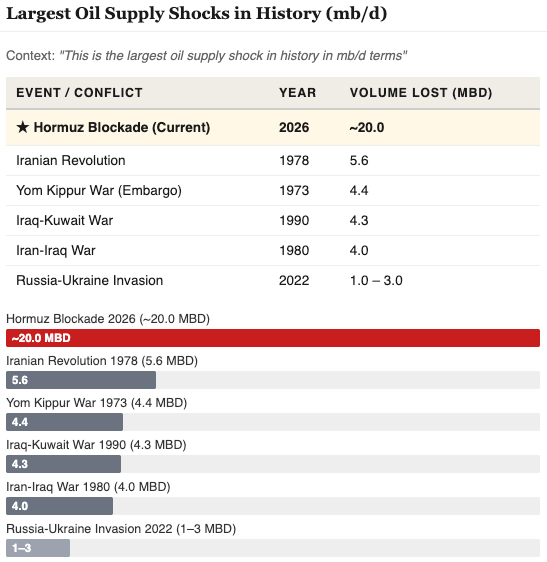
Where Prices Stand Right Now?
At first glance, the price table looks like any other volatile period in oil markets:
|
Benchmark |
Price |
30-Day Change |
|
Brent Crude (global standard) |
$107.34/bbl |
+34.2% |
|
WTI (U.S. domestic) |
$94.30/bbl |
+21.8% |
|
Dubai/Oman (Gulf physical) |
$111.45/bbl |
+41.0% |
But the number that actually tells you what is going on is not on that table. It is the $12.93 gap between Brent and WTI, the widest it has been since 2011.
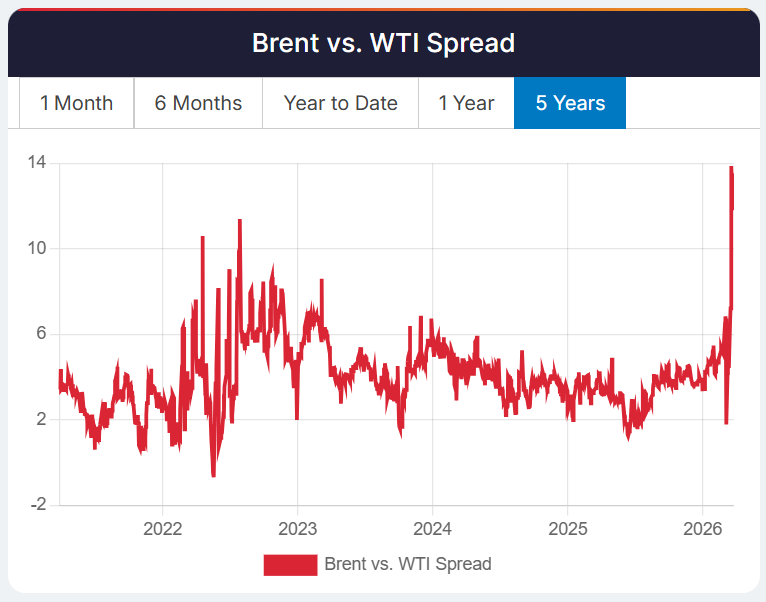
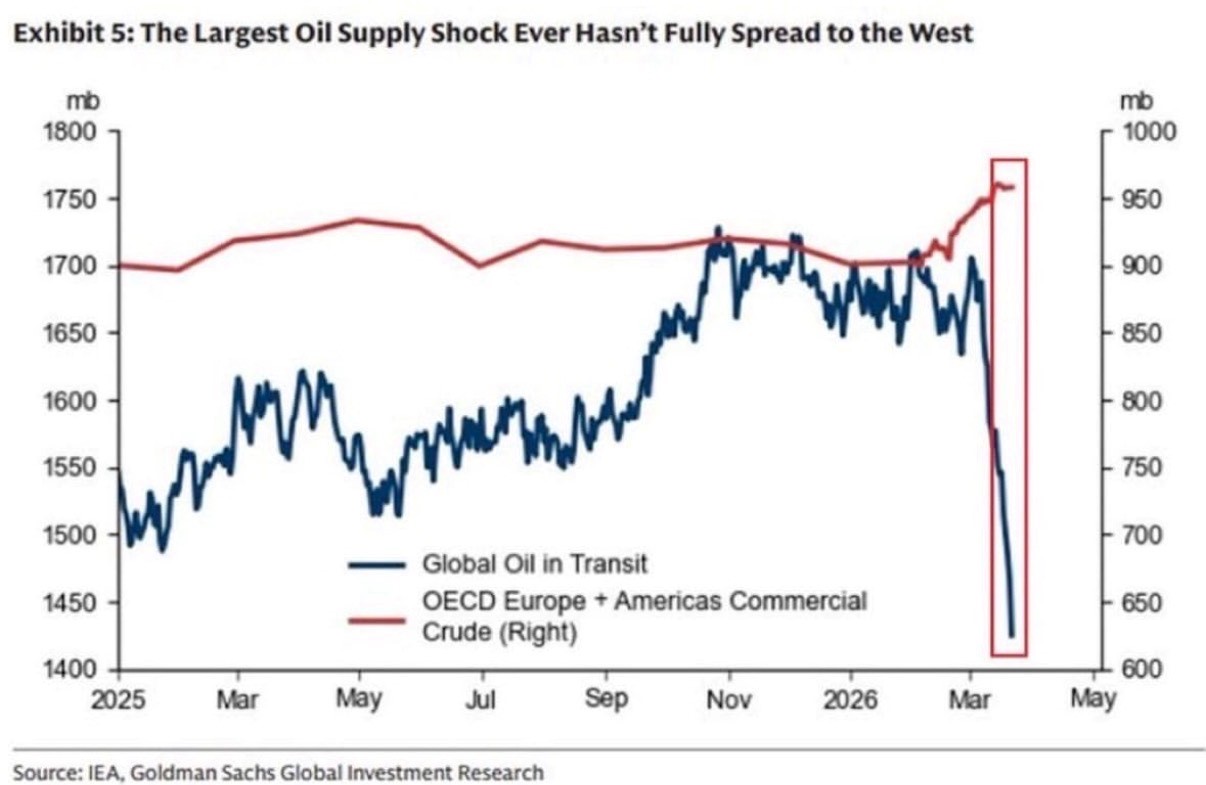
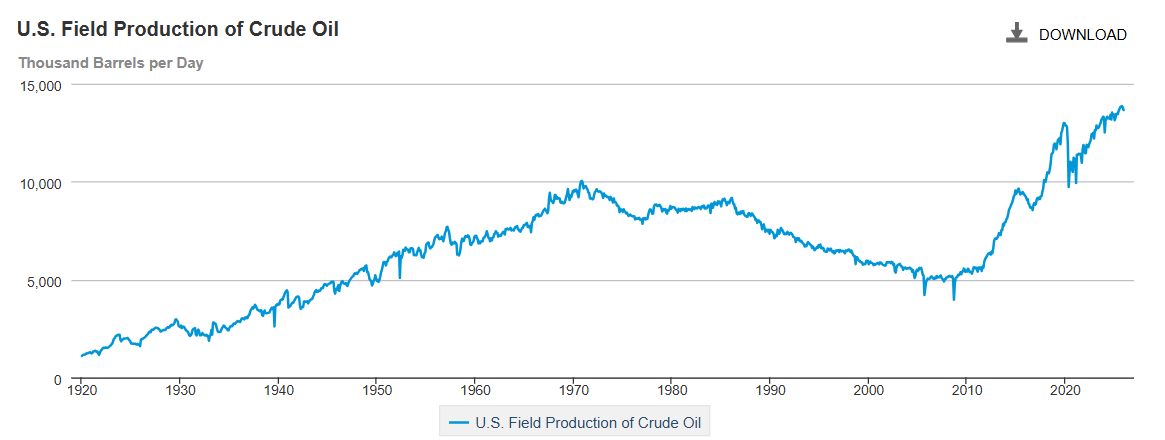
That gap is the market's way of saying: the United States, sitting on record domestic production of 13.7 mb/d, is living in a different energy reality right now than Europe and Asia. America is sheltered. The rest of the world is scrambling. That gap is the scramble made visible.
How Did We Get Here? Crisis Timeline
Nobody should pretend this came out of nowhere. But even people watching closely were caught off guard by the pace.
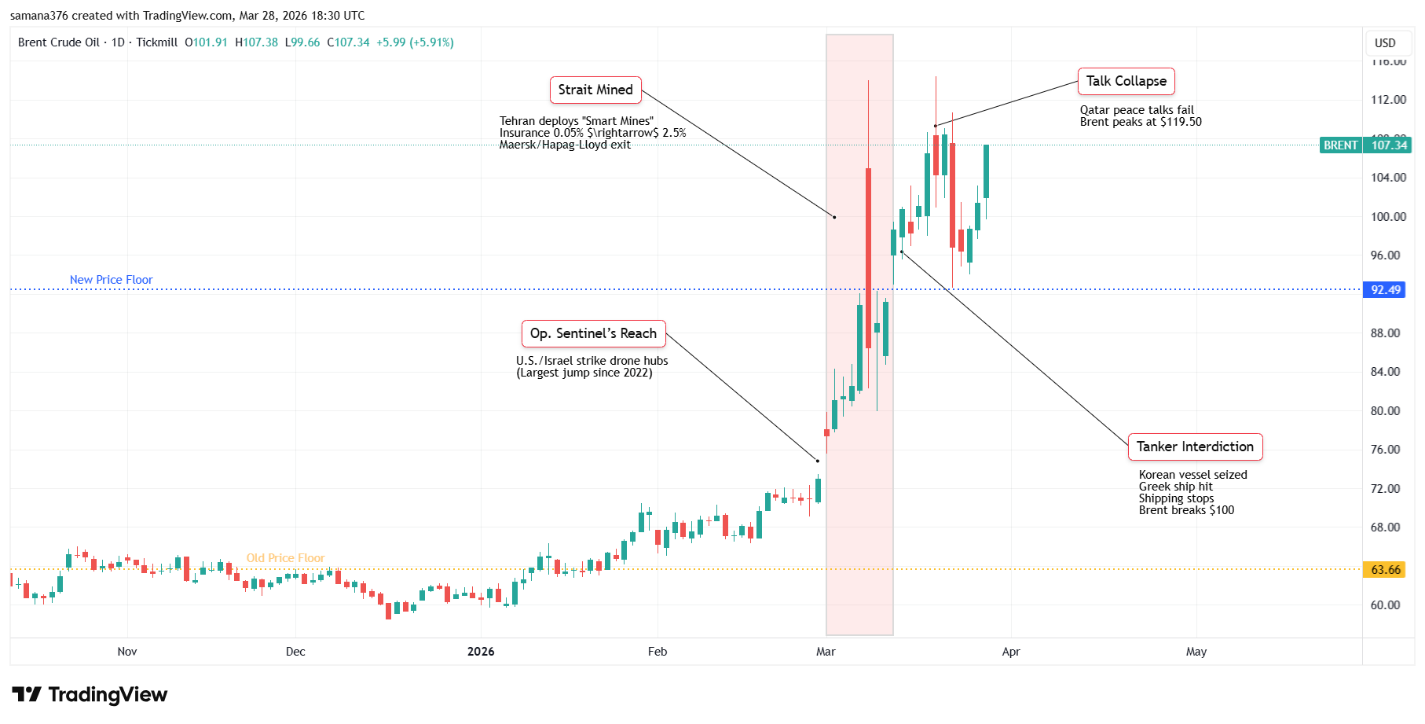
- February 28th was the ignition point. After a series of cyber attacks on regional infrastructure, U.S. and Israeli forces launched Operation Sentinel's Reach against Iranian drone manufacturing sites. Brent jumped $8.40 in twelve hours. That single session move was the largest since Russia invaded Ukraine in 2022.
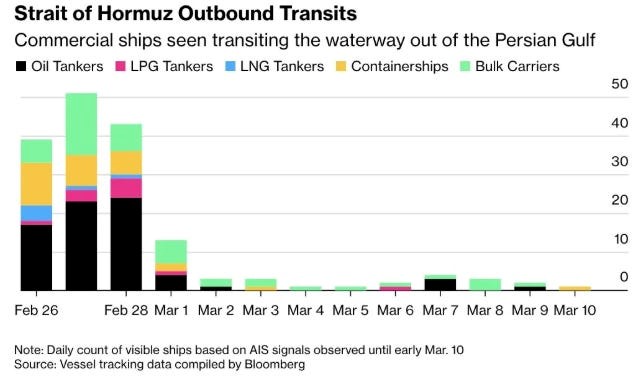
- The first week of March is when it got structural. Tehran deployed what it calls "smart mines", remotely controlled naval mines, in the narrowest section of the Strait. Within days, shipping insurance costs went from 0.05% to 2.5% of a vessel's total value. Run that math on a $100 million oil tanker and a single voyage now costs $2.5 million just to insure, before you spend a dollar on fuel or crew. Maersk and Hapag-Lloyd, two of the world's largest shipping operators, pulled out of the Gulf entirely.
- March 12th ended any remaining ambiguity. A Korean tanker was seized. A Greek vessel took a hit from a loitering munition, essentially a slow drone that glides toward a target and detonates on contact. Commercial shipping didn't slow down. It stopped. Brent crossed $100 for the first time in four years.
- March 20th was supposed to bring some relief, with peace talks convening in Qatar. They collapsed. Markets drew the obvious conclusion, this is not a blip, and Brent ran to $119.50 before settling back to where it sits today at $108.16.
That pullback is worth addressing directly, because people are misreading it as a sign things are improving. They are not. The floor of this market has moved permanently higher. The retreat from $119 to $108 is not recovery. It is consolidation at a new, elevated baseline.
"Can't the Oil Just Go Another Way?"
It is the logical question, and the answer is: not really, no.
The world normally moves 21 mb/d through the Strait of Hormuz. The only two meaningful bypasses including the Abu Dhabi Crude Oil Pipeline (ADCOP) and Saudi Arabia's East-West Pipeline, can carry a combined 6.85 mb/d at full capacity.
That leaves a gap of over 14 mb/d. There is no pipeline being built, no fleet of trucks, and no emergency reserve large enough to bridge a hole that size. The math simply does not work.
The "Shut-In" Problem: The Crisis Behind the Crisis
Here is the part of this story that deserves far more attention than it is getting.
Gulf oil producers including Saudi Arabia, Kuwait, the UAE, operate almost entirely on a pump-and-ship model. They do not maintain large domestic stockpiles. They produce, and they export, almost simultaneously. So when ships stop moving, the oil has nowhere to go.
By March 15th, onshore storage across the Gulf had hit 95% of total working capacity. At that point, producers face a genuinely ugly choice: keep pumping into a full system, or shut the wells down.
Saudi Aramco has reportedly cut production by around 20%. The reason comes down to geology. Gulf oil fields sit in what are called carbonate rock formations, porous limestone structures where oil pressure and flow behavior are sensitive. Shut a well in this kind of formation improperly, or for too long, and you risk permanent productivity loss. Restarting can take six to twelve months. In some cases, the well never fully recovers.
So when people ask when supply will bounce back once the Strait reopens, the honest answer is: we do not know. Some of this supply may not bounce back at all.
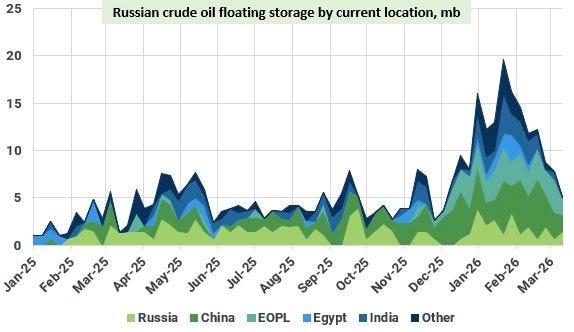
Meanwhile, over 300 supertankers aka VLCCs, the largest class of oil carrier in the world, are sitting idle outside the Gulf of Oman. They are full. The oil exists. The world just cannot get to it, partly because Iranian electronic warfare has filled the Strait's navigation environment with false GPS signals, making it unsafe for a vessel the size of four football fields to attempt the passage. Hence, the crude congestion is escalating.
So Why Isn't Oil at $200?
Three things are holding the price below that level, though none of them are permanent solutions.
- U.S. production is genuinely the biggest one. America pumping flat out at 13.7 mb/d has kept WTI below $100 and given Western buyers a real cushion. The catch is geography, a barrel leaving the U.S. Gulf Coast takes 25 to 30 days to reach Japan or South Korea. Asia's need is immediate. The barrel arrives next month.
- Emergency reserve releases helped calm the initial panic. The U.S. released 45.2 million barrels from its Strategic Petroleum Reserve on March 11th, coordinated with IEA member nations in one of the largest collective interventions the group has ever organized. It worked on market sentiment. It did not work on logistics. A barrel in a Texas reserve facility cannot physically appear in a Singaporean refinery within the week.
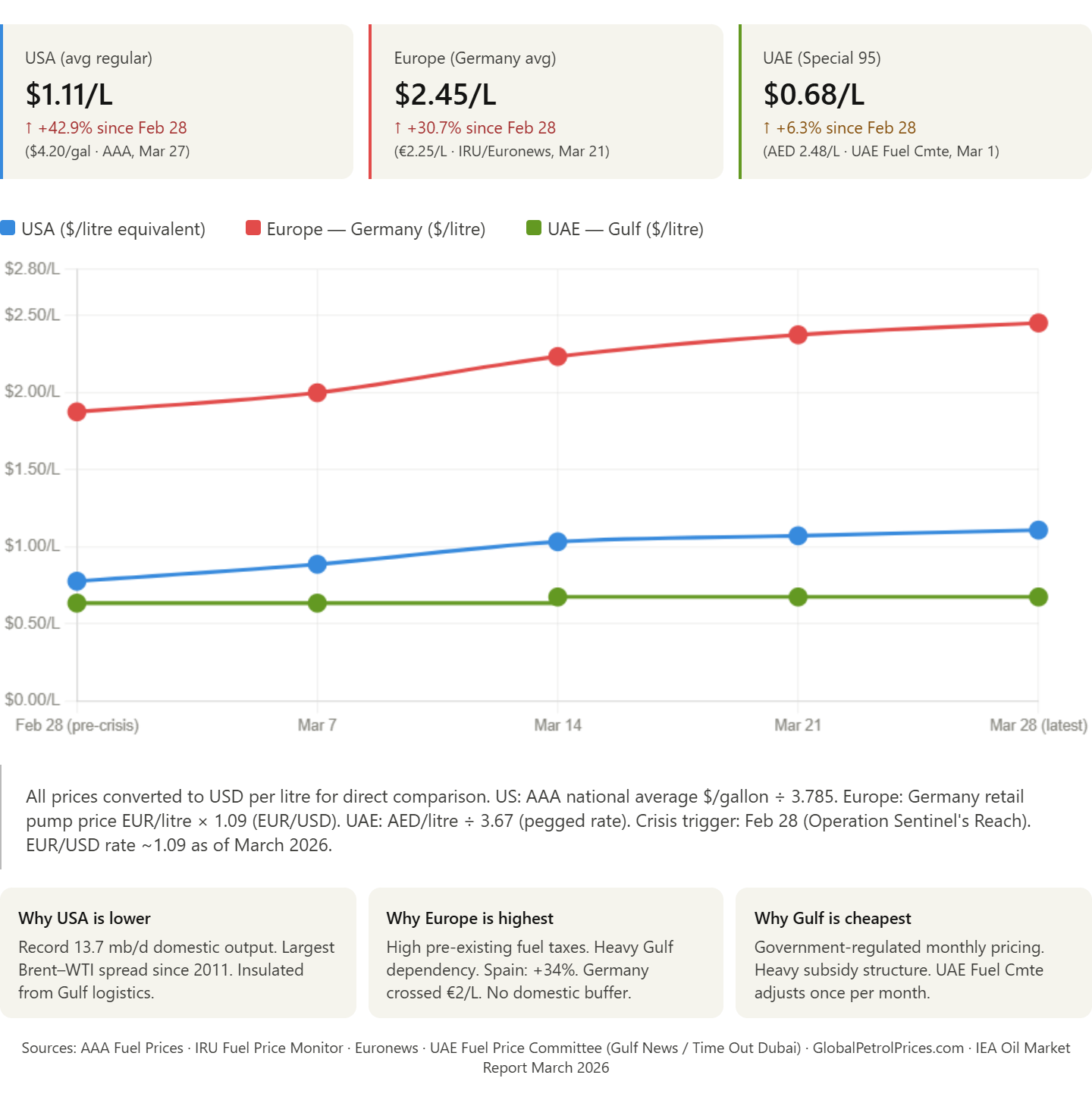
- Demand destruction is the bluntest mechanism of all, high prices forcing people to consume less. At $5.50 a gallon in the U.S. and €2.25 per litre across Europe, discretionary driving has dropped about 12% since late February. People are self-rationing. Prices slow their own rise by reducing consumption. The painful reality is that this adjustment is not distributed evenly. It lands hardest on households with the least financial flexibility and small businesses running on razor-thin margins.
Warflation" — Why This Is More Than an Oil Price Story Economists have landed on a new word for what is happening: Warflation. It describes something different from the inflation most people are familiar with, not too much money chasing too few goods, but military conflict physically destroying the supply chains that keep modern life running. The treatment is different. The trajectory is different. And the damage spreads further.
It is moving through three channels right now.
1- Diesel
Diesel is the first and most immediate. Despite crude sitting at $108, diesel is pricing as though oil were $160. The reason is that diesel requires specific grades of crude; heavier, denser varieties, which come predominantly from the Gulf and from Russian refineries. Those Russian facilities have been steadily degraded by Ukrainian drone strikes over eighteen months. Gulf supplies are now inaccessible. The global middle-distillate market, which powers every truck, train, and tractor on the planet, is functionally broken. The headline crude price understates the economic pressure by a significant margin.
2- Food
Food is the second channel, and it works through a supply chain most consumers never think about. Nitrogen fertilizers like urea, ammonium nitrate, are produced from natural gas, and their shortage will disrupt global food production. Qatar, one of the world's largest LNG exporters, has declared force majeure on its supply contracts. Major fertilizer producers including Yara International and CF Industries have warned of curtailments. Urea prices jumped 19% in a single week in mid-March. That number will show up in crop yields in Q3 2026, particularly across South Asia and the Middle East, regions that are already food price sensitive and have little economic buffer to absorb the shock.
3- Technology
Technology is the third, and the least obvious. TSMC, Taiwan's dominant semiconductor manufacturer, consumes approximately 6% of Taiwan's entire electricity supply. As LNG disruptions raise power generation costs on the island, chip production margins are being compressed. Reports of load-shedding agreements with smaller fabricators are emerging. The global supply chain for AI hardware, already operating with limited redundancy, is being quietly stressed by an energy crisis that started in the Persian Gulf.
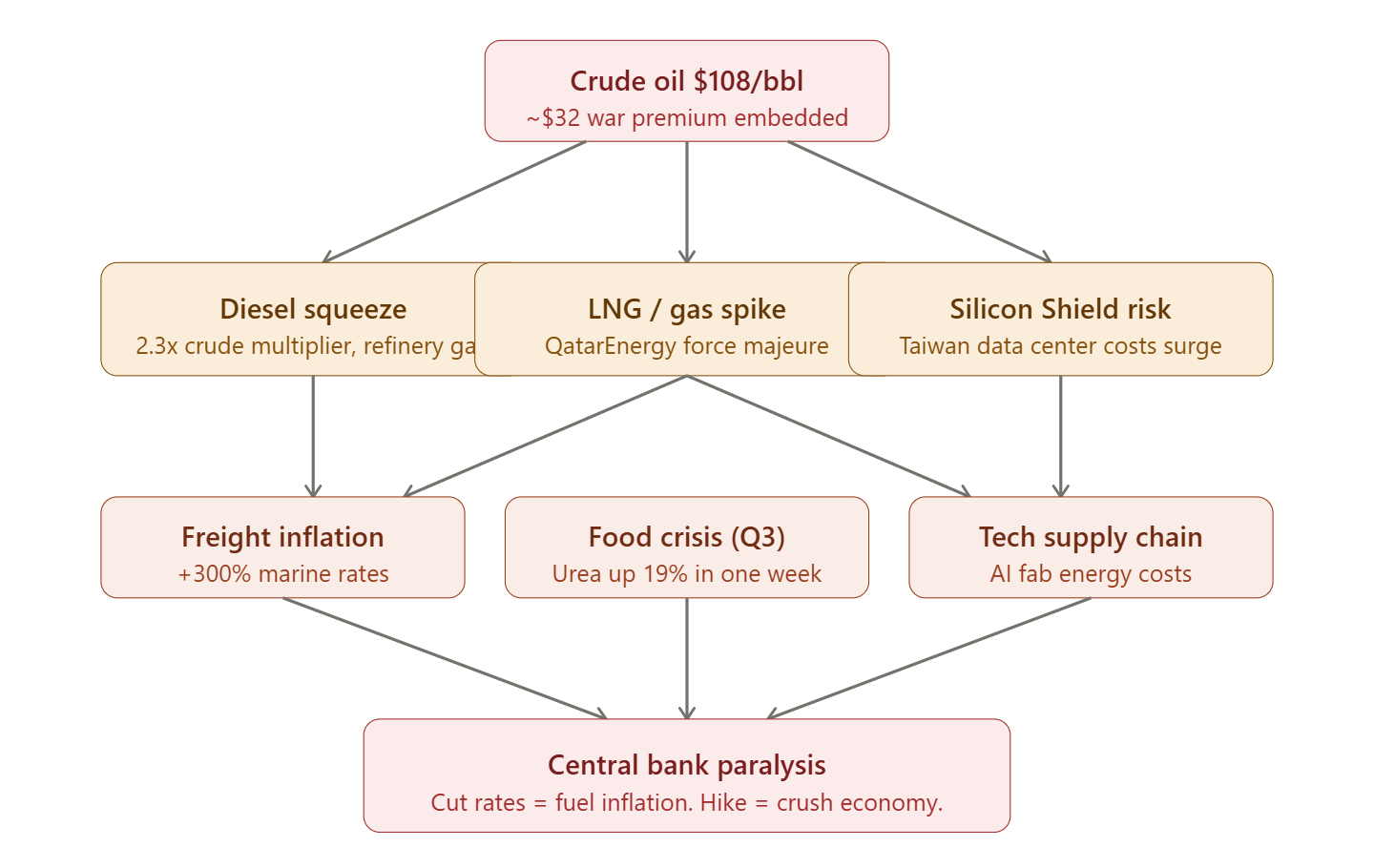
For central banks, all of this converges into a trap with no clean exit. Cut interest rates and you risk entrenching inflation. Raise them and you accelerate the economic contraction that high energy costs are already causing. Neither the Federal Reserve, nor the ECB, nor the Bank of England has a good move available right now.
Possible Ways This Ends – Future Scenarios
|
Scenario |
Probability |
Brent Price |
What It Means for You |
|
Fragile Truce — guarded naval corridor established |
45% |
$90–$105 |
Zero growth, persistent 5% inflation. Expensive, exhausting, but no collapse |
|
Full Escalation — strikes on Saudi oil infrastructure |
35% |
$150–$180 |
1970s-style recession. Trade seizures. Capital flight |
|
Peace Dividend — diplomatic breakthrough |
20% |
$65–$75 |
Markets rally hard. Inflation cools quickly. Central banks regain room to act |
The base case is not recovery. It is managed deterioration. The world learns to live with restricted supply, elevated prices, and structural inflation that refuses to shift. A heavily escorted maritime corridor keeps oil trickling through the Strait at reduced volumes and enormous cost. Growth stalls. Prices stay high. Nobody wins cleanly.
The escalation scenario at 35% is the one that keeps energy analysts genuinely worried. A strike on Saudi Arabia's Abqaiq processing complex — which handles around 7% of global crude supply — would not just block the pipe. It would damage the pump. The price response would be immediate and severe.
The peace scenario at 20% is real, but requires political developments that have no visible pathway right now.
Summing Up
For seven decades, the global oil system operated on one foundational assumption: oil that is produced will be delivered. Price moved. Delivery did not.
The Strait of Hormuz crisis has inverted that. Delivery is now the variable. No rate decision, no reserve release, and no reduction in driving habits can reopen a mined shipping lane or restart a shut-in well on a faster timeline than geology allows.
The winners of the 2026 economy will not be whoever finds the cheapest barrel. They will be whoever can guarantee that the barrel actually shows up.
Written by: Saman Ali

Claim your 50% Deposit Bonus with PU Prime, up to $10,000 by clicking HERE. Sponsored.
Disclaimer:
This article is for informational and educational purposes only and does not constitute financial, investment, trading, or legal advice. Always do your own research or consult a licensed advisor before making trading decisions.


Forex Blog Articles
- How Banks Control the Forex Market: Insider Insights Every Trader Must Know
- The history of Forex Brokers
- Five things to know about the U.S. Federal reserve bank
- How to use seasonal trends to trade Commodity CFDs?
- Costs Associated With Forex Trading
- Does using an expert advisor help you make money in forex?
- What is open interest in futures and how can it help forex traders?
- Why most news traders fail?
- STP or Market Maker; Does it really matter? Are there more important things to know?
- How to choose your Forex Broker
