

Displaying items by tag: oilwar
The Oil War on Your Plate: How Iran War Is Causing Global Food Crisis 2026

The Oil War on Your Plate: How Iran War Is Causing Global Food Crisis 2026
After a Pakistan-brokered ceasefire briefly calmed markets last week, the Islamabad talks collapsed on two irreconcilable points: Iran's insistence on controlling the Strait of Hormuz and its refusal to dismantle its nuclear program. Trump called it "a really good meeting, except for the one thing that really mattered."
The Strait of Hormuz is still closed. And now, the US has moved from diplomacy to naval blockade.
The Strait of Hormuz food supply route, through which 27% of global oil exports, 20% of LNG, and up to 30% of the world's fertilizer trade flows, has been functionally impaired since February 28.
Does oil war cause food shortage? The answer is Yes.
Urea fertilizer is still 50% more expensive than pre war levels. The Northern Hemisphere's spring planting window is closing with farmers short on nitrogen they cannot source or afford. And the supply chain disruption, slow-moving, invisible, and already in motion, will take 6 to 12 months to fully surface in harvest yields, grocery prices, and hunger statistics.
This article is about that oil war food crisis 2026. What the oil war has already done to the global food system, and what happens to your grocery bill, and to 45 million people on the edge of acute food insecurity, if situation goes further wrong.
How Oil Becomes Food?
Most people know that higher oil prices mean higher gas prices. What far fewer people understand is that oil impact on food supply chain runs far deeper. Oil doesn't just move food, it fundamentally makes it. There are three different channels through which an oil price shock reaches your dinner table, and they operate on very different timelines.
1- Transportation:
Diesel powers every truck, ship, and train that moves food from farm to processor to warehouse to shelf. Higher fuel costs hit first and compound at every single handoff in the food supply chain.
2- Fertilizer:
Nitrogen fertilizers are made from natural gas and oil-linked commodity. Energy price spikes drive fertilizer price spikes. However, this channel has a 6–12 month delay before it shows up in harvest yields and food production costs.
3- Biofuels:
When crude is expensive, biofuel crop diversion food crisis becomes more profitable. Governments divert corn, palm oil, and soybeans into energy instead of food. Hence, it causes tight global grain supplies and ultimately drives up food prices across the board.
Now Why Your Grocery Bill Hasn't Peaked Yet?
If you are wondering how does oil price affect grocery prices in practice, the answer is: slowly, then all at once.
A 2025 analysis from the Federal Reserve Bank of Kansas City confirmed what any supply chain analyst will tell you: a 10–20% oil price increase doesn't translate one-for-one into grocery prices right away. Rather, the full effect takes months to work through multiple layers of the system. But when it does arrive, food inflation is stickier and harder to reverse than energy prices. And the fertilizer channel's 6–12 month delay means the worst of this year's shock is still ahead of us.
What’s the Fertilizer Crisis?
While crude oil prices dominate the headlines, the smarter money is watching fertilizer prices 2026. And what its showing should alarm anyone who eats. The situation is arguably worse than the oil crisis, because there is no emergency release valve for fertilizer shortages and just like other shipments, fertilizer shipments are also blocked at the strait, making the Hormuz blockade food supply chain disruption far more dangerous than most realize.
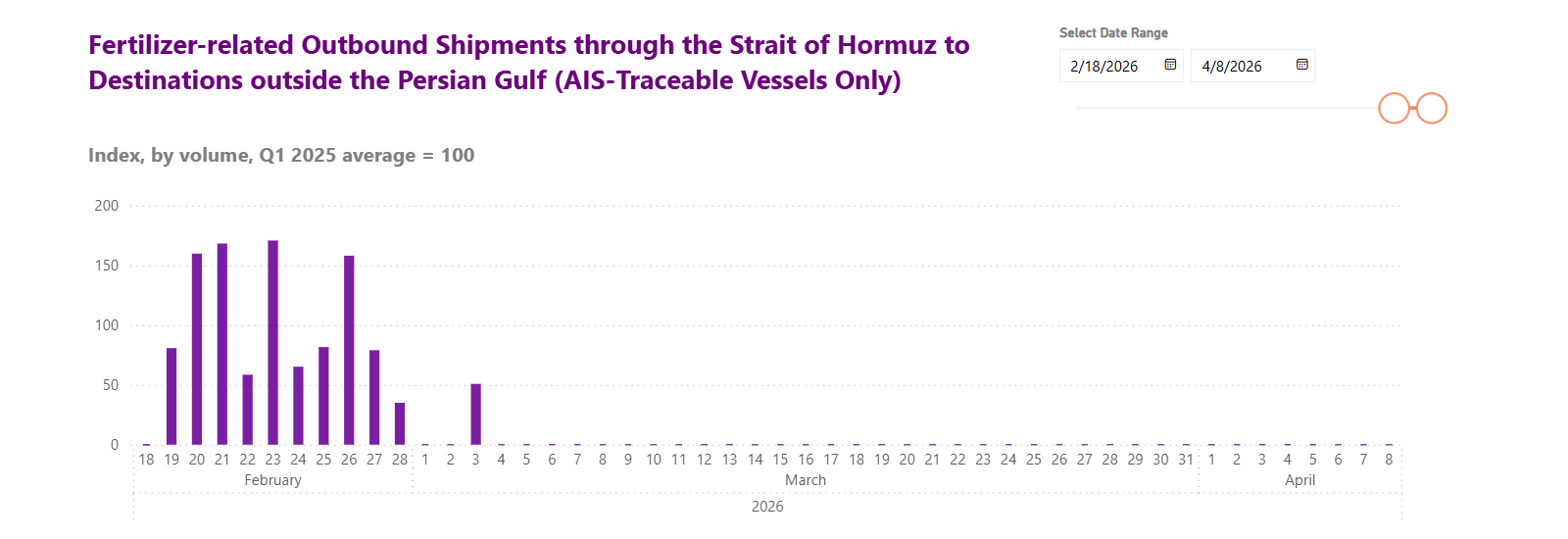
The cost of FOB granular urea in Egypt, which is the global bellwether for nitrogen fertilizer prices, has jumped from $400–$490 per metric ton before the war to around $700 per metric ton. Oxford Economics reports that urea prices agriculture 2026 are up roughly 50% and ammonia around 20% since February 28. In the United States, urea at the New Orleans import hub jumped 32% in a single week, from $516 to $683 per metric ton, with prices up 77% from mid-December 2025. Timing couldn't be worse, because, this is peak spring planting season.
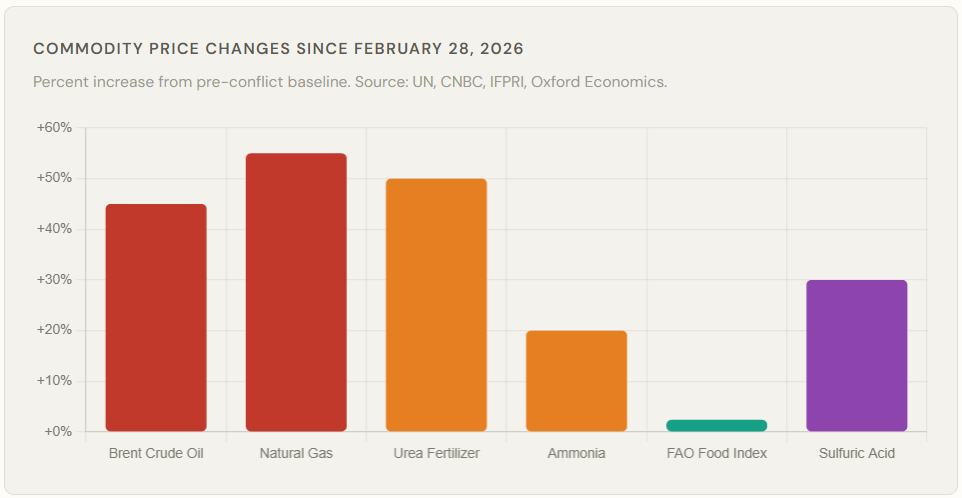
What makes fertilizer prices so catastrophic is structural. Countries hold strategic petroleum reserves which means, governments can release oil to buffer a supply shock. In contrast, there is no strategic fertilizer reserve anywhere on the planet. No bypass pipeline for urea. No OPEC-equivalent that can ramp production overnight. Therefore, Hormuz crisis is really two crises sharing one waterway, and the fertilizer crisis has absolutely no shock absorber.
According to IFPRI, the Middle East controls an outsized portion of the global fertilizer market, with Saudi Arabia, Iran, Qatar, Kuwait, and the United Arab Emirates exporting 36% of global urea shipments, nearly 50% of global sulfur trade, and 25% of ammonia worldwide. In contrast to the Russia/Ukraine war, which had impacted only one or two big producers of fertilizer, this conflict has affected all of them at once, therefore causing food insecurity.
Food Prices Overview
Data is starting to move – and it's all in the same direction. Will food prices go up because of Iran war? They already have.
According to the UN Food and Agricultural Organization (FAO), there has been a 2.4% increase in its FAO Food Price Index 2026 in March alone, the biggest single-month increase since 2022. Food cereals prices increased around 1.7% month-on-month, with the sole driver behind the move being increased fertilizer and energy prices, causing Iran war food inflation.
In addition, according to USDA projections, there will be 3.6% of overall food price increases in 2026, with beef being 14.4% costlier compared to last year as of February. Eight of 15 food-at-home categories in the USA are currently experiencing annual growth rates above their historical averages of the past 20 years.
What's more important, according to FAO's forecast, if fertilizer use decreases due to the high costs, the next round of harvest would be reduced, triggering harder food price wave during the latter part of 2026. This is not a forecast; this is agricultural math.
Who is at Most Risk?
Not all countries will feel this food security oil price shock equally. The vulnerability will depend on three primary factors: dependence on food imports, exposure of the energy sector to changes in global oil price dynamics, and, crucially, how much of the household budget is used to purchase food items.
The lower the income level, the higher the vulnerability of this population. The pattern of food inflation Middle East 2026 data already confirms this — and for developing countries food oil shock exposure, the situation is especially acute.
|
Region / Country |
Food as % of Income |
Primary Exposure |
Risk |
|
Sub-Saharan Africa |
50–70% |
Grain imports, fertilizer access, currency weakness |
Critical |
|
South Asia (India, Pakistan, Bangladesh) |
45–60% |
Heavy LNG & fertilizer imports from Gulf; thin reserves |
Critical |
|
Gulf States (food importers) |
30–45% |
90%+ food import dependency; Hormuz is their supply lane |
Critical |
|
Europe |
12–20% |
Diesel, jet fuel & fertilizer sourced from Gulf; gas price surge |
High |
|
Latin America (Brazil) |
18–28% |
World's largest fertilizer importer — 49M metric tons in 2025 |
High |
|
United States |
~10% |
Domestic energy buffer; urea import costs hit spring planting hard |
Moderate |
|
China |
~18% |
Large strategic reserves; slower-burning, longer-term exposure |
Moderate-Low |
With the Brent oil price currently standing at $110 per barrel, 55% increase from late-February level of $71, the model suggests food prices may increase by 14%. This means that for families spending 70% of their income on food, food price hikes will equate to a sudden drop of 10% in real income.
And it is not luxury items that get cut first; it's proteins, fruits, and vegetables. When young children under age of five lack food intake, it's a developmental disability that negatively impacts their cognitive ability, education, future earnings and nothing helps.
Historical Relationship Between Brent Crude & Food Price Index
If this situation sounds eerily familiar to you, it is because it is. FRED's data show how the Global Food Price Index moves together with Brent crude through any major geopolitical shock. Be it 2000-2005 energy boom, the food price hike amid the global financial crisis that briefly pushed Brent prices above $147 in 2008, the Arab Spring food riots that triggered further price increase in 2011 or the Russia/Ukraine War in 2022, when Brent surpassed the $120 mark and sent the FAO Food Price Index to an all-time peak.
The following image shows crude oil food prices correlation.
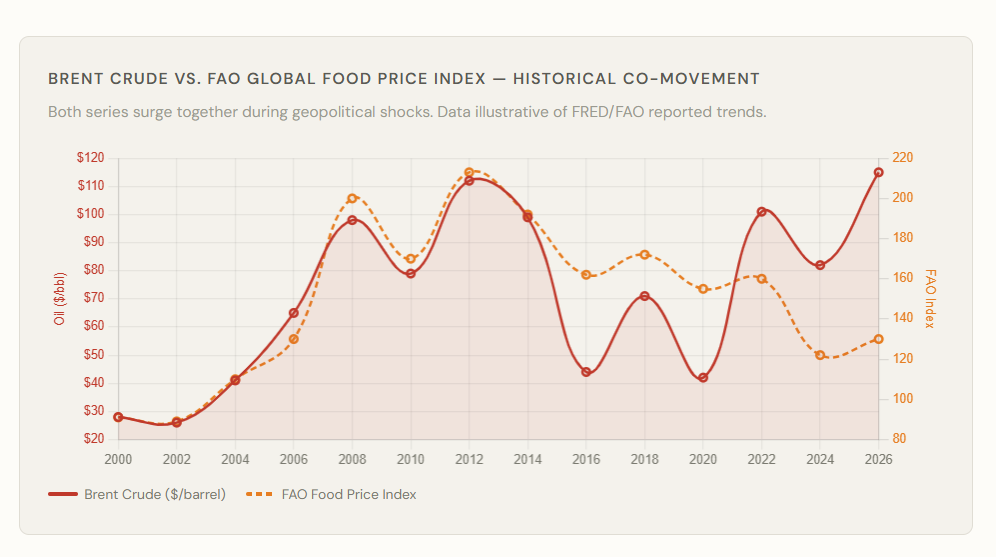
Each episode led to an unfolding food crisis, which was proportional to the duration of energy shock. Brent crude food inflation is not new, but in 2026, the duration of the crisis becomes the critical factor. Analysts suggest that the threat of inexpensive drones to the security of oil supply is what keeps the Strait closed despite multiple ceasefires; and that drone-based threats might linger for months even after launch facilities have been destroyed.
No wall is necessary across the Strait of Hormuz – the lingering threat will keep insurance companies out of business in the region. And this is already happening.
The Stagflation Threat is Real
Currently, the Brent oil price hovers around $100 a barrel. Economic growth forecasts are being revised downward. IMF projects an increase in global inflation and will release a new report on economic impact of war on global economy on April 14th.
This is a classic stagflation scenario: prices rising while growth slowing. The 1973 oil embargo and 1978 Iranian Revolution both started exactly like this – leading to global recession that lasted years.
The Fed finds itself in a dilemma without an easy way out. If the action against a short-lived energy shock occurs too early, this would lead to more problems rather than solve them. But delaying the reaction will allow stagflation food prices – far more stubborn and lasting – to embed itself in the economy.
Three Possible Scenarios for What Comes Next
How bad it gets will depend entirely on whether there will be a ceasefire agreement signed in Islamabad this weekend – and in the weeks to follow. The International Food Policy Research Institute warns of potential disruptions of fertilizer delivery to Asia as the most serious problem, if Hormuz remains closed.
Below are the probabilities of each of three scenarios:
Scenario 1- Ceasefire agreement holds
Pakistan’s Foreign Minister Ishaq Dar is pushing both sides to hold the ceasefire and keep talking. If quiet pressure gets them back to negotiations within days and an agreement lands quickly, the Strait reopens. Oil cools off to around $75–80. Food prices begin to settle, but the damage to spring planting is already locked in, so autumn 2026 harvests still come in below normal. Even in this best-case path, the system carries a few months of built-in strain.
Scenario 2- Partial ceasefire agreement; fragile peace
Both sides stick to a tense, no-shooting truce, but nothing moves diplomatically. The Strait remains effectively shut, and the US port blockade keeps pressure on Iranian exports. Brent hovers in the $95–105 range. Fertilizer stays expensive through the critical planting window. By Q3 2026, food prices jump 8–12% in import-dependent regions. The WFP’s projection of 45 million people facing hunger starts to materialize. Overall, global food security takes a noticeable hit.
Scenario 3 - Ceasefire fails; conflict continues
The US blockade provokes retaliation from Iran, and the Strait stays closed through the summer. Fertilizer shortages during spring planting lock in weaker autumn harvests across Asia and Africa. UN ESCAP estimates the region-wide inflation at 4.6% in 2026. However, this forecast is based on assumption that ceasefire will hold. With it failing, the numbers would deteriorate quickly. Financial models pointing to $150+ oil in a prolonged conflict stop looking extreme and start looking realistic. At that stage, the 2026 global food crisis isn’t hypothetical anymore.
Summary
While this crisis may sound like an energy story, this has never been the case. This is a global food crisis 2026, slowly developing across supply chains, fertilizer invoices, transportation costs, and planting decisions that have yet to be fully priced in.
Tragically, the people who did nothing to ignite this geopolitical dispute are the ones who suffer the most. Usually, an oil war is fought between military forces and diplomats. And a food crisis unfolds among families and in kitchens. But, right now, those two things are the same and falls under one crisis.
Written by: Saman Ali
Disclaimer:
This article is for informational and educational purposes only and does not constitute financial, investment, trading, or legal advice. Always do your own research or consult a licensed advisor before making trading decisions.


