

Displaying items by tag: nvidia
Big Tech Q1 2026 Earnings: AI Winners, Losers & Nvidia Outlook

Big Tech Just Had Its Best Quarter in Years. So Why Is the Market Still Nervous?
What happens when the biggest problem facing tech stocks is not poor earnings... but impossible expectations?
That is the true story of Q1 2026 earnings season.
On the surface, tech stocks just delivered one of their best earnings reports in recent memory. But beneath the headlines, something even more interesting is occurring: artificial intelligence is driving a huge divide within the tech sector itself. Some stocks are about to enter an accelerated growth cycle. Other stocks are quietly being left behind.
And now, with Nvidia set to report earnings tonight, we're finally going to see if the bull run in artificial intelligence can keep going... or whether the tech market has become too optimistic about its future growth.
If you're invested in tech stocks right now, then this is the earnings briefing you need.
The Earnings Season That Changed Wall Street's Expectations
The numbers were astounding.
Despite more than 90% of S&P 500 companies having already reported Q1 2026 earnings, profit growth is currently tracking to near 27% growth year over year – double what Wall Street expected heading into earnings season.
That means this has been the best quarterly earnings growth period since 2021.
And with roughly 83% of S&P 500 companies having beaten their forecasts this quarter, that number has actually been even higher than usual.
Then why is the market still nervous?
Because earnings beats do not matter.
Investors no longer want just good results. They want perfection.
S&P 500 companies which missed expectations have fallen short of market indices by almost 5% in the day following earnings. By contrast, companies which beat estimates managed only a modest 1% gain.
Why?
Because strong earnings are already baked in.
The market is now assuming AI-driven growth will continue accelerating.
And that makes the next few days very important.
The Big Tech Earnings Scorecard: Who Really Won?
The most intense earnings battle took place the week of April 29th, when Microsoft, Alphabet, Amazon, and Meta all released earnings on consecutive days before Apple did on the fifth.
But despite all of them having performed well in terms of earnings growth, not all big tech stocks impressed investors.
|
Metric |
Alphabet |
Amazon |
Microsoft |
Apple |
Meta |
|
Q1 2026 Revenue |
$109.9B |
$181.5B |
$82.9B |
$111.2B |
$56.31B |
|
Revenue Growth YoY |
+22% |
+17% |
+18% |
+17% |
+33% |
|
Core AI / Cloud Segment |
Google Cloud |
AWS |
Azure |
Services Ecosystem |
AI Advertising & Infrastructure |
|
AI / Cloud Growth |
Google Cloud +63% |
AWS +28% |
Azure +40% |
Services margins ~77% |
Ad revenue + AI monetization acceleration |
|
Earnings Highlight |
Net income +81% |
EPS nearly doubled estimates |
AI business ARR reached $37B |
EPS +22%, China sales +28% |
Daily active users hit 3.58B |
|
AI Infrastructure Spending |
2026 capex guide: $180B–$190B |
Planning over $200B capex |
Projected ~$190B capex |
Roughly $13B annual capex |
$115B–$135B AI capex guide |
|
Investor Reaction |
Biggest winner of earnings season |
Positive but underhyped |
Strong results but muted reaction |
Investors split on AI positioning |
Stock dropped nearly 7% post-earnings |
|
Biggest Investor Concern |
Rising AI spending intensity |
Can margins hold during massive expansion? |
OpenAI exclusivity ending |
Is Apple falling behind in AI? |
Spending rising faster than monetization |
|
Main Bullish Thesis |
Fastest-growing hyperscaler with huge AI backlog |
AWS becoming backbone of AI infrastructure |
Enterprise AI dominance |
Massive profitability with low capex |
Unmatched scale for AI-driven advertising |
|
Key Market Narrative |
AI strategy clearly working |
Quiet AI infrastructure giant |
Great results no longer enough |
Efficiency vs AI race debate |
Market demanding faster AI returns |
1- Alphabet was the Clear Winner
Alphabet delivered one of the strongest quarters of the bunch.
Its Google Cloud business generated a remarkable 63% year-over-year growth to $20 billion, which accelerates dramatically from 48% growth in Q4 2025, and now makes Google Cloud the fastest-growing hyperscaler in this cycle.
Why?
Because Alphabet proved yet again that its entire AI strategy is working.
From custom AI chips to an ever-growing backlog of orders, a strong search engine ad market, to cloud acceleration, everything is pointing to one thing:
Alphabet becoming one of the leading AI infrastructure companies on Earth.
And investors can tell.
2- Amazon Quietly Built an AI Advantage of its Own
AWS growth soared by 28% year over year to $37.6 billion.
It's the strongest cloud growth Amazon has seen in 13 consecutive quarters.
Advertising revenues rose 23%.
But the real story is infrastructure.
All major AI labs use AWS computing power, while Amazon is planning to spend over $200 billion in capex in the upcoming year in anticipation of growing AI demand.
Here's the question investors need to answer now:
Could Amazon become one of the biggest AI infrastructure leaders without drawing the same investor attention as Nvidia and Microsoft?
3- Microsoft Had Excellent Results But Not Good Enough for Markets
In Q1 2026, Microsoft delivered Azure growth of 40% and total revenue of $82.9 billion.
Historically, such numbers would've generated a monumental rally.
But this time, investors responded quite tepidly.
Why?
Because Microsoft suddenly appeared somewhat underwhelming compared to Alphabet's growth in its cloud services.
Not only did Microsoft end its exclusive partnership with OpenAI, giving its competitor free access to all its frontier models until 2032, but it also made many investors question:
Is Microsoft's dominance in AI over now?
4- Apple Stock May Be the Most Exciting One to Watch in Tech This Year
Apple delivered arguably the best results of the season.
Q1 2026 saw total revenue grow 17% to $111.2 billion, and EPS jump by 22%. Greater China sales skyrocketed by 28% to $20.5 billion, and the company's services segment maintained its acceleration with gross margins staying at about 77%.
However, investors' eyes cannot stop looking at a single number:
Apple managed all of this while spending no more than $13 billion per year on capex investments.
How does that compare to Microsoft's projected $190 billion, and Amazon's $200 billion AI buildout in the year ahead?
Now investors have to decide for themselves:
Was Apple able to generate spectacular results while saving billions over its competitors' costs in AI infrastructure projects?
Or is the technology giant quietly lagging in AI development?
This question will define Apple's valuation in the coming two years.
5- Meta Revealed Investors' Biggest Fear in AI
Meta delivered excellent results once again with 33% y-o-y and $56.31 billion in revenue.
Ad growth stayed robust, while daily active users reached a staggering 3.58 billion users.
But investors ignored the positive numbers, fixating their sights on expenses.
Meta said it plans to spend between $115 billion to $135 billion building AI infrastructure next year alone.
The stock dropped almost 7% after earnings.
That move reveals something important about today's market:
Investors only reward heavy AI spending when returns rise faster than costs.
If spending is outpacing monetization, investors punish the companies involved ruthlessly.
AI Is Creating an Emerging Class of Winners and Losers Among Tech Stocks
Another trend emerging during this earnings season is the huge performance discrepancy between technology stocks.
Since the start of Q1 2026 earnings, there has been a difference of 133 percentage points between the top-performing and worst-performing stocks in technology this year.
The gap is widening. Three years ago, the discrepancy between tech stocks barely reached 75 points.
The time of AI lifting the entire industry is over. Now some companies are starting to emerge as leaders in this field.
The Winners: Tech Stocks Focused on Hardware and Semiconductors
As you would probably expect, the winners this earnings season include companies focusing on AI infrastructure development.
SanDisk shares are up a whopping 511% YTD. Intel delivered blowout Q1 results which pushed its revenue up over 225%. Seagate Technology and Western Digital have soared by roughly 194% and 183%, respectively.
VanEck Semiconductor ETF has surged by 58% YTD, too.
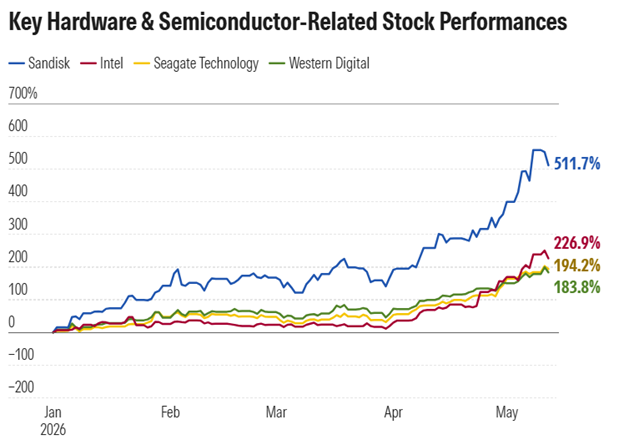
Image Source: Morningstar
Why?
Because artificial intelligence needs a lot of semiconductors, chip memory, networking, and storage solutions to process massive amounts of data.
The Losers: AI-Destroyed Software Companies
The software sector has experienced massive pain this earnings season.
Over 75% of stocks in the Morningstar US Technology Index are negative in 2026.
HubSpot's stock price is down almost 50%. Atlassian's shares are down about 47%. Workday has dropped by roughly 44%.
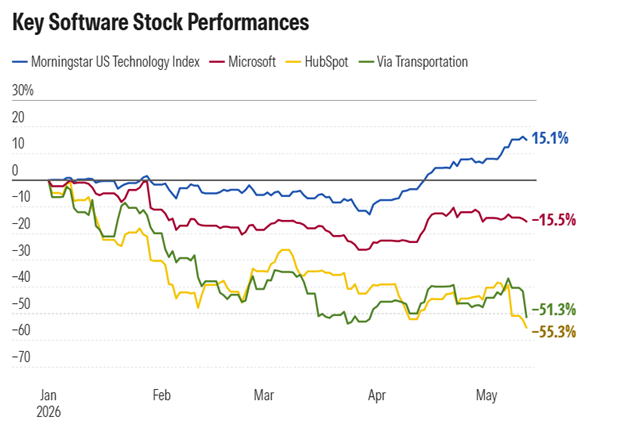
Image Source: Morningstar
Why?
Because more and more software investors are worrying about AI potentially disrupting their companies' business models.
That may end up being overly pessimistic. After all, many analysts predict that software companies will simply adapt to new technologies.
But for investors in technology stocks, that means taking a chance.
Holding a broadly-diversified tech stock ETF no longer means getting great exposure to AI innovation. Many of those indexes now contain software stocks that can significantly drag down AI's gains.
The First Phase of Artificial Intelligence IPO Boom Is Here
The next phase of the AI growth cycle is starting now with several IPOs.
Last week, Cerebras Systems debuted on Nasdaq in what's shaping up to be the biggest tech IPO since Uber's initial listing in 2019.
The company raised $5.55 billion, opening its trading at $350 per share, and closing with a 68% increase to a valuation of about $95 billion.
Cerebras builds AI-focused wafers-cale processors for inferencing purposes – the area investors worry could soon become AI's main bottleneck.
But besides signing a $20 billion cloud deal with OpenAI and a massive infrastructure contract with Amazon Web Services, the company faces competition from Nvidia, and poses real customer concentration risks.
Investors should therefore be careful.
But there's another message the market wants to send clearly:
The appetite for AI companies listed on the Nasdaq remains immense.
And the IPO pipeline ahead with Databricks, OpenAI, Anthropic, and Elon Musk's SpaceX xAI company merger, could soon provide us with the biggest wave of tech listings in years.
Nvidia Earnings Could Decide the Future of All AI-Related Stocks
The coming earnings season will hinge on Nvidia's performance.
The street predicts the tech titan will deliver adjusted EPS of about $1.77, and a revenue number of $78.9 billion for this quarter – both implying over 79% YOY growth.
But what truly caught everyone's attention is Nvidia's Q1 data center revenue, predicted to exceed $73.3 billion, which is a near 87% rise from last year.
And with analysts predicting Nvidia's FY 2027 revenues reaching almost $370 billion (about 71% growth), tonight's earnings become extremely crucial.
Why?
Because the market stopped caring about earnings misses long ago.
They assume Nvidia will beat analysts' expectations.
But tonight they'll want to see something different:
Strong guidance for future earnings driven by Nvidia's Blackwell AI chips, hyperscaler demand, and AI spending in infrastructure.
The Two Risks Facing Nvidia and All Artificial Intelligence-Linked Companies
But there are two other problems tech stocks are facing right now.
Rising bond yields and crude oil prices.
Yields on the 10-year and 30-year US Treasuries have climbed to 4.6% and 5.2%, respectively. 30-Year US treasury hit its highest level in 19 years since 2007.
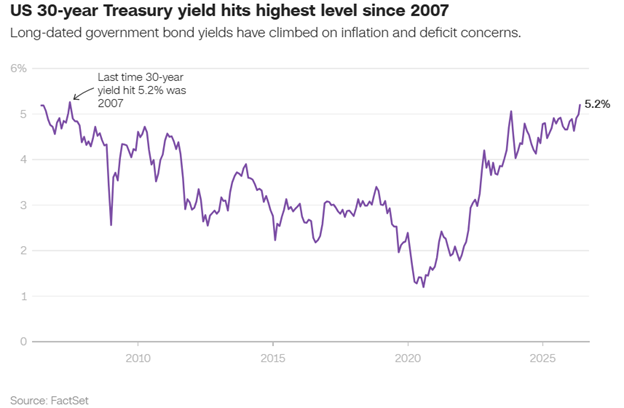
Oil prices are also on the rise due to Strait of Hormuz supply issues, now pushing them above $100 per barrel. This is fuelling fears of renewed inflation and potential tightening by the Federal Reserve.
Why is this relevant?
Because rising bond yields hurt companies valued primarily on their future growth, cutting down the present value of their future cash flows.
That is why the Nasdaq fell and several stocks in Magnificent Seven declined despite posting blowout results.
That leaves two risks investors must consider while watching Nvidia's earnings:
Will the AI growth narrative remain intact for investors? And can artificial intelligence momentum offset rising bond yields?
If Nvidia's guidance for FY 2027 turns out solid and positive for investors with news on Blackwell AI chips, hyperscalers' demands, and AI infrastructure spending... Then Nvidia's decline after the report will create another buying opportunity for premium artificial intelligence stocks.
But if Nvidia fails to impress, rising bond yields can spark a much deeper correction among the entire class of AI tech stocks.
Written by: Saman Ali
Disclaimer:
This article is for informational and educational purposes only and does not constitute financial, investment, trading, or legal advice. Always do your own research or consult a licensed advisor before making trading decisions.
Q4 2025 Earnings Review: AI Leadership in Tech vs. Structural Headwinds in Energy

Q4 2025 Earnings Review: AI Leadership in Tech vs. Structural Headwinds in Energy
Tech and Energy Earnings Review Q4 2025: An in-depth study of Nvidia, Apple, Microsoft, and energy giants based on data-driven information to guide investors.

Key Insights
- Broad-based earnings strength was achieved through technology companies, which was due to continued AI and cloud investment.
- The outcome of the energy sector showed both positive and negative performance due to decreased crude prices and narrowing of the margins.
- The AI infrastructure investment remained in the process of redefining capital investment in the two sectors.
- Investors in 2026 have to deal with valuation discipline and geopolitical risk management as well.
Introduction:
With the end of Q4 2025 earnings season, investors have a better idea of how the major technology and energy companies have fared in the face of enduring geopolitical tensions, higher interest rates, and structural changes as a result of artificial intelligence.
FactSet reports that earnings of the S&P 500 increased in high single digits on a year-over-year basis. Nonetheless, there was an increase in sector dispersion. Technology was at the forefront, using AI-driven revenues, and energy companies were adapting to fluctuations in prices and regulatory risks.
This review considers the true performance in terms of earnings of the major companies and weighs their strategic impact on long-term investors.
Technology Sector Performance

NVIDIA: Continued Domination in AI Infrastructure.
Financial Highlights (Q4 FY2025):
- Revenue: $57.0B(+78% YoY)
- EPS: $0.89 (+80% YoY)
- Gross Margin: ~73%
- Data Center Revenue: $35.6B
NVIDIA has reported another record quarter, where the hyperscaler market of advanced GPUs and AI systems is in demand. Backlog orders stretched to fiscal 2026, which strengthens the revenue on a long-term basis.
Investment-wise, Nvidia is the fundamental beneficiary of the worldwide adoption of AI, but the sensitivity of valuation has been elevated.
Microsoft: Cloud and Enterprise Stability
Financial Highlights:
- Revenue: $81.3B(+18% YoY)
- EPS: $3.65 (+24% YoY)
- Net Income: $27.2B
- Azure Growth: High-teens %
The Q4 performance of Microsoft was an indication of a high use of cloud and artificial intelligence-based productivity tools by enterprises. Azure was one of the key growth drivers, and Copilot adoption increased ecosystem stickiness.
Microsoft continues to present to its investors a growth, cash-generating, and defensive stability profile.
Apple: Ecosystem Resilience
Financial Highlights:
- Revenue: $143.8B(+8% YoY)
- EPS: $1.85 (+13% YoY)
- Gross Margin: 47.2%
- Services Revenue: All-time high.
The hardware sales of Apple were still not evenly distributed in regions, especially in China. The increase in services and ecosystem monetization, however, counterbalances the cycle of devices.
The performance of Apple confirms the transition towards a recurring-revenue-based model of the business.
Intel: Gradual Recovery Phase
Financial Highlights:
- Revenue: $13.7B (–4% YoY)
- EPS: –$0.06 (GAAP)
- Gross Margin: Moving in the right direction.
- Foundry Investment: Ongoing
Intel went on with its restructuring and manufacturing rearrangement. As much as the profitability is still under pressure, better utilization rates and demand for the AI-server are giving encouragement for stabilization.
Energy Sector Performance

ExxonMobil: Cash Flow Resilience
Financial Highlights:
- Earnings: $6.5B
- EPS: $1.53
- Operating Cash Flow: $12.7B
- Free Cash Flow: $5.6B
Reduced crude prices forced margins down, but restrained capital allocation and efficiency in the upstream saved shareholders' returns.
Chevron: Operational Discipline
Financial Highlights:
- Revenue: $46.9B
- EPS: $1.52
- Cash Flow: $10.8B
The performance of Chevron pointed out the cost efficiency and strength of the balance sheet as a buffer to commodity cycles.
Shell: LNG and Trading Strength
Financial Highlights:
- Adjusted Earnings: $3.3B
- Free Cash Flow: $9.4B
- Buybacks: Continued
The Shell gas and LNG trading business operations were integrated, which added stability even when the refining margin pressure was high.
PetroChina: Policy-Driven Stability
Even though all Q4 2025 data is not available, the recent performance of PetroChina is characterized by:
- 2024 Net Profit: $23B+ (record level)
- Production Growth: +2.5% YoY
- Capital Support by the State.
The national energy administration in China is still focused on national energy security, which upholds the upstream investments and price stability of PetroChina. The volatility of earnings is mitigated by government-supported infrastructure expenditure and long-term contracts on supplies.
To the investors, PetroChina comes with a stability that is backed by policies but with little upside because of the controlled prices.
Earnings Snapshot
|
Company |
Revenue |
EPS |
YoY Trend |
Key Driver |
|
Nvidia |
$57.0B |
$1.30 |
Strong |
AI chips |
|
Microsoft |
$81.3B |
$4.14 (Non-GAAP) / $5.16 (GAAP) |
Strong |
Cloud |
|
Apple |
$143.8B |
$2.84 |
Strong |
iPhone & Services |
|
Intel |
$13.7B |
$0.15 (Non-GAAP) / –$0.12 (GAAP) |
Weak / Improving |
Restructuring |
|
ExxonMobil |
~$82.3B |
$1.53 (GAAP) / $1.71 (Adj.) |
Mixed |
Upstream |
|
Chevron |
$46.9B |
$1.52 |
Stable |
Efficiency |
|
Shell |
$64.1B |
~$1.12 (Adj.) |
Mixed |
LNG |
|
PetroChina |
~719B CNY (~$100B+ USD) |
~0.23 CNY (~$0.03 USD) |
Stable |
Policy Support |
Valuation and Downside Risks
Overvaluation Risk
The stocks of mega-cap technology have higher multiples than the historic average. There are several ways Nvidia and Microsoft are exposed to compression in case AI expenditure levels off.
China Exposure
Apple, Nvidia, and Intel are exposed to demand risk due to the export control and regulatory restrictions on China-related revenues.
Policy and Regulatory Risk
Continued lowering of Brent prices to below $60 may strain the margins of Exxon, Chevron, and Shell companies, especially in downstream operations.
Policy and Regulatory Risk
- AI governance rules
- Antitrust regulation
- Costs of environmental compliance.
- Carbon pricing mechanisms
These are potential limiting factors to long-term profitability.
Investment Implications
Technology
- The structural growth is preserved.
- The AI expenditure is multi-year.
- Importance of valuation discipline.
Preferred exposure: Nvidia, Microsoft, Apple.
Energy
- Pay attention to the durability of cash flow.
- The LNG and the integrated models are favored.
- Critical Dividend Sustainability.
Preferential exposure Shell, ExxonMobil (selective).
Conclusion
Q4 2025 profitability verified a growing performance disparity amid the technology and energy industries. AI-based infrastructure investment remains the driver of the earnings growth of the major tech-oriented companies, with energy companies being limited by pricing and regulation opportunities.
To the investors, there are three themes dominating:
- AI continues to be the main driving force of world profits.
- Diversification and capital restraint are the determinants of energy profitability.
- The valuation risks and geopolitical risks need to be selectively positioned.
Sustainable cash generation and structural growth exposure would continue to be at the center of the long-term returns as markets enter 2026.
Reference Links

Disclaimer:
This article is for informational and educational purposes only and does not constitute financial, investment, trading, or legal advice. Always do your own research or consult a licensed advisor before making trading decisions.
Q1 2025 Earnings Season: Navigating Market Volatility Amid Trade Wars, Global Conflict & a Shifting World Order

Q1 2025 Earnings Season: Navigating Market Volatility Amid Trade Wars, Global Conflict & a Shifting World Order

The opening quarter of 2025 brings with it an earnings season shrouded in macroeconomic uncertainty and geopolitical upheaval. Investors around the globe are confronting a whirlwind of shifting dynamics: heightened U.S.-China trade tensions, evolving military conflicts in Ukraine and the Middle East, growing regulatory scrutiny on Big Tech, and a cultural pendulum swing from progressive, ESG-focused corporate strategies toward nationalism and traditionalist values. These developments are reverberating across global equity markets, influencing risk sentiment, consumer demand, corporate earnings, and forward guidance. In this new paradigm, earnings reports are no longer just about revenue beats and EPS surprises — they are a referendum on how companies are responding to an unprecedented global backdrop.
Several large-cap multinationals are expected to revise guidance or signal caution moving forward. Tariffs are pushing up raw material costs and eroding margins. Rising global defense spending and energy volatility are distorting sectoral performance. In addition, the investing public is more polarized than ever, with consumer activism increasingly influencing corporate reputations and share price performance. As the financial world attempts to navigate these complexities, Q1 2025 will likely set the tone for the rest of the year. Investors are preparing for volatility spikes and sharp sector rotations, while institutional analysts are placing greater emphasis on macro-resilience and geopolitical adaptability.
Global Market Backdrop

-
Tariff Escalation: The U.S. recently enforced a new round of punitive tariffs on Chinese imports, ranging from 45% to 145% on items like electric vehicles, steel, semiconductors, and solar panels. These protectionist measures are forcing companies to reassess supply chains and consider nearshoring strategies. In retaliation, China has slapped countermeasures on agricultural goods, tech imports, and U.S. luxury brands. The tit-for-tat measures have reignited fears of a prolonged trade war reminiscent of 2018-2019 but with deeper inflationary consequences.
-
Energy Disruption & War: The war in Ukraine has entered its third year, and the situation in the Middle East remains volatile with intermittent military escalations impacting oil shipping routes and natural gas exports. European economies are struggling with energy rationing concerns, while U.S. shale producers are caught between ESG compliance and profit-seeking mandates.
-
Cultural & Political Shifts: A global shift away from progressive ideology in corporate strategy is unfolding. Companies that previously championed ESG and DEI policies are facing backlash from politically active shareholder groups and grassroots consumers. This cultural realignment is influencing everything from advertising strategy to hiring policies, with many corporations attempting to remain apolitical amid the noise.
-
Interest Rates and Inflation: The Federal Reserve has kept rates steady but hinted at a pause in rate hikes. However, sticky inflation, especially in services, remains a concern. The market is split on whether a soft landing is possible. Consumer confidence is recovering slightly, but wage growth is slowing.
-
Dollar Volatility: The U.S. dollar has weakened slightly against a basket of major currencies amid central bank divergence and risk aversion. Currency headwinds are a major factor for export-heavy companies.
Sector Analysis
Technology Sector

The technology sector enters Q1 2025 under a microscope. After years of being market leaders, Big Tech firms are now grappling with regulatory scrutiny, declining consumer sentiment in China, and margin pressures from supply chain disruptions caused by tariffs. Nevertheless, the growth of AI, cloud services, and semiconductors continues to drive long-term optimism.
-
Microsoft (MSFT): Microsoft is expected to post steady growth, largely driven by its Azure cloud services and AI-integrated offerings across enterprise platforms. Analysts project EPS growth of 12% YoY, while margin stability will be tested due to heightened infrastructure spending. Microsoft's productivity suite, enhanced with Copilot AI, is gaining traction, especially among enterprise users aiming to optimize remote workflows.
-
Apple (AAPL): While Apple maintains strong brand loyalty, the company faces headwinds in China amid growing support for domestic smartphone brands and political tension. Hardware sales are expected to slow, but services and wearables could provide a revenue cushion. Market attention is also focused on Apple’s upcoming Vision Pro release and its potential to unlock a new product category.
-
Alphabet (GOOGL): Google’s advertising revenues remain robust, but YouTube's ad growth is plateauing as it faces competition from TikTok and Meta Reels. Meanwhile, Google Cloud continues to gain enterprise clients, though it still trails AWS and Azure. Alphabet’s investments in AI, through its Gemini models, are being closely watched as they battle OpenAI in the large language model space.
-
Tesla (TSLA): Once defined strictly by EV production, Tesla is now treated by many as a tech company due to its AI and robotics focus. While Q1 deliveries were slightly under expectations, investors are anticipating progress updates on the Optimus robot project and the rollout of Full Self-Driving (FSD) Version 12. Margins remain under pressure due to aggressive global price cuts, but software revenue could turn the tide.
-
Nvidia (NVDA): Nvidia continues to dominate the AI semiconductor market. Expectations are sky-high for Q1 earnings, with revenue growth projected at over 200% YoY, driven by hyperscaler demand for the H100 and H200 chips. Analysts are watching closely for supply chain updates and whether Nvidia can sustain such meteoric growth into the second half of the year.
-
Amazon (AMZN): Amazon’s AWS business remains its profit engine, but e-commerce continues to face inflation-driven margin pressure. Labor costs are rising again, and Amazon’s aggressive investments in warehouse automation and drone delivery will be key talking points. Advertising revenue is another growing segment, helping to diversify its earnings base.
-
Meta (META): Meta has made strong strides in AI-based recommendation engines and its Reels monetization is catching up to TikTok. The Reality Labs division, which includes VR and AR projects, remains a drag on profitability, but Mark Zuckerberg remains committed to a long-term vision of the metaverse. Meta is also expected to benefit from rising ad budgets in 2025.
-
Netflix (NFLX): With its ad-supported tier growing in user base and profitability, Netflix is set to report a solid quarter. However, content costs continue to rise, and password-sharing crackdowns are nearing saturation. The company's push into live sports broadcasting could open new monetization channels.
Banking Sector
The banking sector enters earnings season with cautious optimism. While higher interest rates have improved net interest margins, weakening loan growth, tighter credit standards, and global market volatility are contributing to a more defensive tone. The banking industry remains a bellwether for broader economic sentiment, and analysts will be scrutinizing reserve levels and forward guidance closely.
-
JPMorgan Chase (JPM): As the largest U.S. bank by assets, JPMorgan is often seen as a proxy for financial sector health. In Q1, it is expected to deliver solid performance across investment banking, fixed income trading, and consumer lending. Analysts will be particularly focused on CEO Jamie Dimon's forward guidance and commentary on loan default trends.
-
Bank of America (BAC): With a significant footprint in consumer banking and mortgages, BAC is more sensitive to housing and credit trends. The bank has benefited from higher rates, but analysts expect some pullback in mortgage originations and credit card delinquencies to modestly impact results. Watch for commentary on digital banking adoption and its continued tech investment.
-
Citigroup (C): Citigroup’s global exposure makes it vulnerable to FX fluctuations and emerging market volatility. Its transformation strategy, which includes exiting consumer banking in non-core markets, will be a focus point. Analysts are looking for stabilization in investment banking fees and a clearer roadmap for cost reductions.
-
Goldman Sachs (GS): Goldman is heavily reliant on capital markets and wealth management revenue. Q1 is expected to show gains in equities trading, but deal-making remains well below 2021 peaks. Investors are also evaluating the firm’s consumer finance retreat and strategic reallocation of capital toward private equity and asset management.
-
Wells Fargo (WFC): Still working under a Federal Reserve-imposed asset cap, Wells Fargo continues its long-term recovery. Analysts anticipate modest improvement in efficiency ratios and credit quality. Regulatory compliance updates and expense management efforts will likely dominate the earnings call.
Pharmaceuticals Sector

The pharmaceutical and healthcare sector is poised for an eventful Q1 2025 earnings season. While drug pricing scrutiny and patent cliffs remain pressing concerns, strong demand for specialty therapies and immunology products has supported earnings. Many companies are adjusting strategies to focus on rare diseases, oncology, and biosimilars as traditional blockbusters age out of exclusivity.
-
Johnson & Johnson (JNJ): J&J is likely to show stability due to its diversified operations. The company is expected to report modest growth from its pharmaceutical and med-tech divisions, while its consumer health spin-off Kenvue continues to establish independence. Investors are closely monitoring litigation developments related to talc liabilities and their impact on capital allocation.
-
Pfizer (PFE): Pfizer is transitioning out of its COVID-19 windfall, and the market is watching how it manages this pivot. While revenues are expected to decline YoY, key launches in oncology and anti-viral segments may offset some of the weakness. Strategic acquisitions like Seagen are expected to bolster its long-term pipeline.
-
Gilead Sciences (GILD): Gilead's HIV and hepatitis franchises remain strong, but all eyes are on its oncology portfolio. Trodelvy and cell therapy developments are expected to drive long-term growth. Analysts are focused on Gilead's ability to sustain top-line momentum amid increasing biosimilar threats.
-
AbbVie (ABBV): This quarter marks a pivotal moment as AbbVie continues to absorb the revenue cliff from Humira's patent expiration. The company is depending heavily on Rinvoq and Skyrizi, both of which have shown encouraging double-digit growth. Analysts are also tracking its pipeline and how AbbVie manages R&D productivity.
-
Merck & Co. (MRK): Merck’s Keytruda continues to anchor the company’s performance, with oncology revenues growing steadily. The company is pushing aggressively into personalized medicine and expanding its vaccine pipeline. Analysts anticipate solid earnings supported by new launches and an improving margin profile.
Oil & Gas Sector

The oil and gas sector is entering Q1 earnings season with a mix of geopolitical tailwinds and regulatory headwinds. Elevated crude oil prices—driven by Middle Eastern tensions and OPEC+ supply discipline—are helping to stabilize revenues. However, ESG constraints, rising input costs, and government pressure to accelerate renewable transitions are also shaping corporate strategies.
-
ExxonMobil (XOM): Exxon is expected to report strong earnings, supported by higher upstream margins and robust refining profits. The company’s Guyana oil project continues to exceed expectations, and Exxon’s disciplined capital expenditure strategy has earned praise from Wall Street. Investors will look for updates on carbon capture initiatives and international production volumes.
-
Chevron (CVX): Chevron is seeing healthy free cash flow thanks to stable oil prices and strong operational execution in the Permian Basin. The company is also ramping up LNG investments in Asia and Australia. Analysts are paying close attention to CVX’s energy transition strategy and updates on cost optimization across its value chain.
-
Shell (SHEL): Shell is balancing its fossil fuel legacy with green ambitions. Q1 is expected to reflect improved refining margins and natural gas trading profits. However, Shell’s renewable investments are still in early stages, and returns remain modest. Market focus is on the pace of divestitures and their impact on long-term profitability.
-
BP (BP): The company is at a crossroads, pivoting toward clean energy while maintaining core oil production. BP is under pressure from shareholders to improve transparency and returns. Analysts expect flat revenue growth this quarter but will be listening for project updates in offshore wind and hydrogen.
-
Kinder Morgan (KMI): As a major U.S. pipeline operator, Kinder Morgan is expected to benefit from strong domestic gas demand during a colder-than-expected Q1. The company’s midstream earnings should remain solid, but investors will watch debt levels and project execution closely.
Automotive Sector

The automotive sector enters Q1 2025 facing a complex mix of economic, regulatory, and consumer demand dynamics. While EV adoption continues to climb, pricing pressure, rising interest rates, and geopolitical tensions have made profitability more difficult. Supply chain normalization is progressing, but raw material costs remain elevated due to tariffs and regional instability.
-
Tesla (TSLA): Tesla is expected to report modest YoY revenue growth but declining margins due to continued price cuts aimed at defending market share. Investors are keen on updates regarding the Cybertruck ramp-up, FSD advancements, and progress in Tesla’s humanoid robotics program. The company’s AI initiatives could offset some of the pressure on vehicle profitability.
-
General Motors (GM): GM has faced delivery delays and cost pressures, but its strategic pivot toward software-based services is beginning to take form. The Ultium battery platform remains central to its EV ambitions. Analysts are watching closely for updates on Cruise, GM’s autonomous driving subsidiary, following increased regulatory scrutiny.
-
Ford Motor Company (F): Ford’s Q1 is expected to reflect continued investment in EVs and hybrids. The F-150 Lightning and Mustang Mach-E remain key models, although profitability remains challenged due to scale inefficiencies. Analysts are looking for more concrete cost-cutting initiatives and improved factory utilization.
-
Toyota Motor Corporation (TM): Toyota continues to outperform many rivals thanks to its dominant position in hybrid vehicles. Its conservative approach to EV adoption is resonating with cost-conscious consumers and markets where infrastructure remains limited. Q1 earnings should reflect strong performance in both Asia and North America.
-
Volkswagen Group (VWAGY): Volkswagen is targeting efficiency gains in its core brands like VW and Audi while expanding EV production in Europe and China. Software development issues have delayed product launches, but the ID. family is expected to drive near-term volume growth. Q1 will also highlight regional performance, particularly in China amid increasing competition from local brands.
Defense & Weapons Sector

The defense and weapons sector is one of the few industries poised for structural growth in 2025, supported by rising global military budgets, ongoing geopolitical instability, and NATO expansion initiatives. Defense stocks have outperformed broader markets year-to-date, and Q1 earnings will reflect increased order backlogs, government contracts, and R&D spending aimed at modernization and cybersecurity.
-
Lockheed Martin (LMT): Lockheed is expected to report strong Q1 results driven by sustained demand for the F-35 fighter jet, missile systems, and classified space programs. Investors are closely watching the company's free cash flow and its ability to meet production schedules amid labor shortages and supply constraints.
-
Raytheon Technologies (RTX): With exposure to both aerospace and defense, Raytheon benefits from commercial aviation recovery as well as missile defense contracts. Its radar and hypersonic programs are expected to generate double-digit order growth. Analysts are interested in how Raytheon manages synergies from its recent mergers and tackles inflationary pressures on component sourcing.
-
Northrop Grumman (NOC): A major player in strategic deterrent systems and space-based defense, Northrop is set to report a solid quarter. The company is ramping up production of the B-21 Raider stealth bomber and expanding missile defense partnerships in Europe and the Indo-Pacific. Cybersecurity and C4ISR integration projects continue to drive backlog growth.
-
L3Harris Technologies (LHX): Upgraded by Goldman Sachs earlier this year, L3Harris is showing agility in navigating changing DoD priorities. The company's edge lies in tactical communication systems, unmanned platforms, and electronic warfare capabilities. Q1 earnings should show strong cash flow and a growing pipeline of contracts.
-
Rheinmetall AG (RHM.DE): Europe's largest munitions manufacturer, Rheinmetall, is benefitting from rising EU defense budgets. It is repurposing automotive plants to produce artillery and armored vehicles. Investors will focus on execution of new NATO orders and its role in the EU's long-term defense industrial strategy.
Retail Sector

Retailers face mounting pressure in Q1 2025 as inflation weighs on consumer discretionary spending and social sentiment reshapes brand loyalties. Companies that rely on volume and value propositions are gaining share, while those in the premium and discretionary categories are battling soft traffic and tighter margins. Inventory management, digital strategy, and consumer sentiment are the key narratives.
-
Walmart (WMT): As a defensive stalwart, Walmart continues to benefit from its low-price positioning. Grocery and pharmacy remain growth drivers, while e-commerce penetration is improving. Analysts expect modest top-line growth with stable margins, and investors are watching global segment performance, particularly in Mexico and India.
-
Target (TGT): Target is seeing pressure from declining discretionary categories such as apparel and home goods. The company is focusing on margin recovery and traffic stabilization via exclusive partnerships and store remodels. Q1 earnings will reflect heavy discounting, which could weigh on profits.
-
Costco (COST): The wholesale giant remains strong, supported by food and household staples. Membership renewals remain high, and expansion into Asia continues. Investors are monitoring inflation's impact on basket size and expectations for a potential membership fee increase in 2025.
-
Nike (NKE): Nike’s Q1 will highlight inventory reductions and international performance, especially in China. DTC (Direct-to-Consumer) continues to grow, but weak wholesale performance and foreign exchange headwinds could drag on results. Analysts are watching closely for updates on innovation and new product rollouts.
-
Home Depot (HD): With the U.S. housing market slowing, Home Depot is facing reduced demand for large renovation projects. Pro-customer activity is moderating, and Q1 results may reflect a dip in same-store sales. Analysts expect modest EPS growth as the company tightens costs and focuses on high-margin categories.
Food & Beverage Sector

The food and beverage sector has experienced mixed results heading into Q1 2025, shaped by changing consumption patterns, high input costs, and shifting brand loyalty dynamics. While consumer staples have historically been a defensive play, even these giants are feeling the pressure of cost inflation and changing dietary trends. Brand trust, global expansion, and cost discipline are the primary themes investors are monitoring.
-
Coca-Cola (KO): Coca-Cola continues to post steady global volume growth, supported by emerging markets and its diverse beverage portfolio. Analysts expect flat margins this quarter as raw material costs remain high. Investors are watching for commentary on new product innovation, such as zero-sugar variants and functional beverages.
-
PepsiCo (PEP): With strong performance in its snacks division, PepsiCo is expected to outperform peers. Revenue growth from Latin America and Asia will likely offset softness in North America. Analysts will focus on price elasticity across its beverages and snack brands amid continued promotional activity.
-
McDonald’s (MCD): McDonald’s is expected to post resilient same-store sales, driven by its value menu offerings and digital ordering app adoption. However, international growth, especially in Europe, may be impacted by currency fluctuations and economic headwinds. Investors are also curious about McDonald's push into plant-based menu items.
-
Starbucks (SBUX): Starbucks faces mixed dynamics. While U.S. same-store sales are expected to rise modestly, China’s recovery remains uneven. Labor cost inflation and rising commodity prices could pressure margins. Analysts will look for growth catalysts in its mobile loyalty program and new store development strategy.
-
Kraft Heinz (KHC): Kraft Heinz is struggling to maintain volume growth, even as price hikes slow. Private label competition is intensifying in the U.S. and Europe, and retailers are demanding more flexibility on pricing. Analysts expect modest EPS growth but will listen closely for cost optimization measures and SKU rationalization efforts.
Earnings Calendar Highlights

The following earnings calendar highlights key reporting dates for many of the top 100 companies by market capitalization. These dates will play a crucial role in shaping market sentiment throughout the earnings season:
| Date | Companies Reporting |
|---|---|
| April 15 | JPMorgan Chase, Citigroup, Bank of America, Goldman Sachs, Wells Fargo |
| April 16 | Johnson & Johnson, Morgan Stanley, Lockheed Martin, Prologis, Charles Schwab |
| April 17 | Abbott Laboratories, American Express, U.S. Bancorp, Halliburton, Discover Financial |
| April 22 | Tesla, Netflix, GE, IBM, United Airlines |
| April 23 | Boeing, Visa, Texas Instruments, Anthem, Mondelez |
| April 24 | Amazon, Intel, Snap, Ford Motor Company, Coca-Cola |
| April 29 | Microsoft, Alphabet (Google), General Motors, 3M, Spotify |
| April 30 | Meta Platforms, Qualcomm, CVS Health, Kraft Heinz, Boeing |
| May 1 | Apple, PayPal, Shopify, Caterpillar, McDonald's |
| May 7 | Starbucks, AMD, Toyota, Moderna, Uber Technologies |
| May 9 | Walt Disney, Volkswagen Group, AstraZeneca, Airbnb, AIG |
| May 28 | Nvidia, Costco Wholesale, Salesforce, Dell Technologies, Dollar Tree |
Investors should pay close attention to these dates for potential volatility, especially in sectors tied to global trade, consumer spending, defense, and AI innovation.
Final Thoughts:

Q1 2025 is shaping up to be a pivotal moment in global financial markets. Against the backdrop of intensifying trade wars, ongoing geopolitical conflicts, and a shift in societal expectations, companies are being tested on their agility, resilience, and relevance. This earnings season is not merely about quarterly profits — it’s about how corporate leadership adapts to complexity, communicates uncertainty, and positions itself for long-term value creation.
For investors, the stakes are high. Sector rotation, macro-driven volatility, and evolving consumer preferences will dictate short-term price action. But within this turbulence lies opportunity. Technology companies that show clear paths to AI monetization, defense firms aligned with national security policy, and consumer brands that resonate with shifting cultural identities could emerge as the defining winners of the post-pandemic investment cycle.
Ultimately, the Q1 2025 earnings season is more than just a litmus test of performance — it is a forward-looking pulse check on the global economic order. Traders, institutions, and long-term investors must remain vigilant, nimble, and informed as this complex narrative continues to unfold. Stay tuned, stay diversified, and keep a watchful eye on earnings calls — because in 2025, it’s not just about beating the numbers. It’s about understanding the message between the lines.
Let us know of your thoughts in the comment section below, and feel free to navigate on our website and choose the right broker for you, to trade the Earnings Season, here: Forex Brokers List .
GeorgiosA
Disclaimer:
This article is for informational and educational purposes only and does not constitute financial, investment, trading, or legal advice. Always do your own research or consult a licensed advisor before making trading decisions.


Forex Blog Articles
- What is Cryptocurrency?
- Forex Triangular Arbitrage Strategy
- What are the top 5 forex platforms
- What is algorithmic trading and how does it work?
- Reactions During Our Trading
- What is forex trading?
- What are currency swap lines and how do they work?
- 5 Things to check before starting your trading session
- How to backtest your forex trading strategies
- Why is fundamental analysis important in trading?
