

Displaying items by tag: analysis
Big Tech Q1 2026 Earnings: AI Winners, Losers & Nvidia Outlook

Big Tech Just Had Its Best Quarter in Years. So Why Is the Market Still Nervous?
What happens when the biggest problem facing tech stocks is not poor earnings... but impossible expectations?
That is the true story of Q1 2026 earnings season.
On the surface, tech stocks just delivered one of their best earnings reports in recent memory. But beneath the headlines, something even more interesting is occurring: artificial intelligence is driving a huge divide within the tech sector itself. Some stocks are about to enter an accelerated growth cycle. Other stocks are quietly being left behind.
And now, with Nvidia set to report earnings tonight, we're finally going to see if the bull run in artificial intelligence can keep going... or whether the tech market has become too optimistic about its future growth.
If you're invested in tech stocks right now, then this is the earnings briefing you need.
The Earnings Season That Changed Wall Street's Expectations
The numbers were astounding.
Despite more than 90% of S&P 500 companies having already reported Q1 2026 earnings, profit growth is currently tracking to near 27% growth year over year – double what Wall Street expected heading into earnings season.
That means this has been the best quarterly earnings growth period since 2021.
And with roughly 83% of S&P 500 companies having beaten their forecasts this quarter, that number has actually been even higher than usual.
Then why is the market still nervous?
Because earnings beats do not matter.
Investors no longer want just good results. They want perfection.
S&P 500 companies which missed expectations have fallen short of market indices by almost 5% in the day following earnings. By contrast, companies which beat estimates managed only a modest 1% gain.
Why?
Because strong earnings are already baked in.
The market is now assuming AI-driven growth will continue accelerating.
And that makes the next few days very important.
The Big Tech Earnings Scorecard: Who Really Won?
The most intense earnings battle took place the week of April 29th, when Microsoft, Alphabet, Amazon, and Meta all released earnings on consecutive days before Apple did on the fifth.
But despite all of them having performed well in terms of earnings growth, not all big tech stocks impressed investors.
|
Metric |
Alphabet |
Amazon |
Microsoft |
Apple |
Meta |
|
Q1 2026 Revenue |
$109.9B |
$181.5B |
$82.9B |
$111.2B |
$56.31B |
|
Revenue Growth YoY |
+22% |
+17% |
+18% |
+17% |
+33% |
|
Core AI / Cloud Segment |
Google Cloud |
AWS |
Azure |
Services Ecosystem |
AI Advertising & Infrastructure |
|
AI / Cloud Growth |
Google Cloud +63% |
AWS +28% |
Azure +40% |
Services margins ~77% |
Ad revenue + AI monetization acceleration |
|
Earnings Highlight |
Net income +81% |
EPS nearly doubled estimates |
AI business ARR reached $37B |
EPS +22%, China sales +28% |
Daily active users hit 3.58B |
|
AI Infrastructure Spending |
2026 capex guide: $180B–$190B |
Planning over $200B capex |
Projected ~$190B capex |
Roughly $13B annual capex |
$115B–$135B AI capex guide |
|
Investor Reaction |
Biggest winner of earnings season |
Positive but underhyped |
Strong results but muted reaction |
Investors split on AI positioning |
Stock dropped nearly 7% post-earnings |
|
Biggest Investor Concern |
Rising AI spending intensity |
Can margins hold during massive expansion? |
OpenAI exclusivity ending |
Is Apple falling behind in AI? |
Spending rising faster than monetization |
|
Main Bullish Thesis |
Fastest-growing hyperscaler with huge AI backlog |
AWS becoming backbone of AI infrastructure |
Enterprise AI dominance |
Massive profitability with low capex |
Unmatched scale for AI-driven advertising |
|
Key Market Narrative |
AI strategy clearly working |
Quiet AI infrastructure giant |
Great results no longer enough |
Efficiency vs AI race debate |
Market demanding faster AI returns |
1- Alphabet was the Clear Winner
Alphabet delivered one of the strongest quarters of the bunch.
Its Google Cloud business generated a remarkable 63% year-over-year growth to $20 billion, which accelerates dramatically from 48% growth in Q4 2025, and now makes Google Cloud the fastest-growing hyperscaler in this cycle.
Why?
Because Alphabet proved yet again that its entire AI strategy is working.
From custom AI chips to an ever-growing backlog of orders, a strong search engine ad market, to cloud acceleration, everything is pointing to one thing:
Alphabet becoming one of the leading AI infrastructure companies on Earth.
And investors can tell.
2- Amazon Quietly Built an AI Advantage of its Own
AWS growth soared by 28% year over year to $37.6 billion.
It's the strongest cloud growth Amazon has seen in 13 consecutive quarters.
Advertising revenues rose 23%.
But the real story is infrastructure.
All major AI labs use AWS computing power, while Amazon is planning to spend over $200 billion in capex in the upcoming year in anticipation of growing AI demand.
Here's the question investors need to answer now:
Could Amazon become one of the biggest AI infrastructure leaders without drawing the same investor attention as Nvidia and Microsoft?
3- Microsoft Had Excellent Results But Not Good Enough for Markets
In Q1 2026, Microsoft delivered Azure growth of 40% and total revenue of $82.9 billion.
Historically, such numbers would've generated a monumental rally.
But this time, investors responded quite tepidly.
Why?
Because Microsoft suddenly appeared somewhat underwhelming compared to Alphabet's growth in its cloud services.
Not only did Microsoft end its exclusive partnership with OpenAI, giving its competitor free access to all its frontier models until 2032, but it also made many investors question:
Is Microsoft's dominance in AI over now?
4- Apple Stock May Be the Most Exciting One to Watch in Tech This Year
Apple delivered arguably the best results of the season.
Q1 2026 saw total revenue grow 17% to $111.2 billion, and EPS jump by 22%. Greater China sales skyrocketed by 28% to $20.5 billion, and the company's services segment maintained its acceleration with gross margins staying at about 77%.
However, investors' eyes cannot stop looking at a single number:
Apple managed all of this while spending no more than $13 billion per year on capex investments.
How does that compare to Microsoft's projected $190 billion, and Amazon's $200 billion AI buildout in the year ahead?
Now investors have to decide for themselves:
Was Apple able to generate spectacular results while saving billions over its competitors' costs in AI infrastructure projects?
Or is the technology giant quietly lagging in AI development?
This question will define Apple's valuation in the coming two years.
5- Meta Revealed Investors' Biggest Fear in AI
Meta delivered excellent results once again with 33% y-o-y and $56.31 billion in revenue.
Ad growth stayed robust, while daily active users reached a staggering 3.58 billion users.
But investors ignored the positive numbers, fixating their sights on expenses.
Meta said it plans to spend between $115 billion to $135 billion building AI infrastructure next year alone.
The stock dropped almost 7% after earnings.
That move reveals something important about today's market:
Investors only reward heavy AI spending when returns rise faster than costs.
If spending is outpacing monetization, investors punish the companies involved ruthlessly.
AI Is Creating an Emerging Class of Winners and Losers Among Tech Stocks
Another trend emerging during this earnings season is the huge performance discrepancy between technology stocks.
Since the start of Q1 2026 earnings, there has been a difference of 133 percentage points between the top-performing and worst-performing stocks in technology this year.
The gap is widening. Three years ago, the discrepancy between tech stocks barely reached 75 points.
The time of AI lifting the entire industry is over. Now some companies are starting to emerge as leaders in this field.
The Winners: Tech Stocks Focused on Hardware and Semiconductors
As you would probably expect, the winners this earnings season include companies focusing on AI infrastructure development.
SanDisk shares are up a whopping 511% YTD. Intel delivered blowout Q1 results which pushed its revenue up over 225%. Seagate Technology and Western Digital have soared by roughly 194% and 183%, respectively.
VanEck Semiconductor ETF has surged by 58% YTD, too.
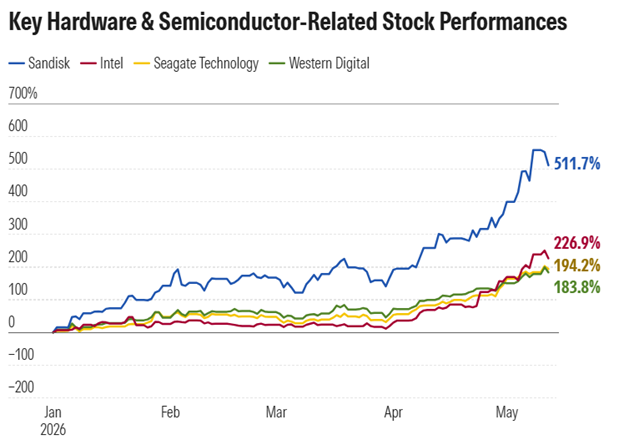
Image Source: Morningstar
Why?
Because artificial intelligence needs a lot of semiconductors, chip memory, networking, and storage solutions to process massive amounts of data.
The Losers: AI-Destroyed Software Companies
The software sector has experienced massive pain this earnings season.
Over 75% of stocks in the Morningstar US Technology Index are negative in 2026.
HubSpot's stock price is down almost 50%. Atlassian's shares are down about 47%. Workday has dropped by roughly 44%.
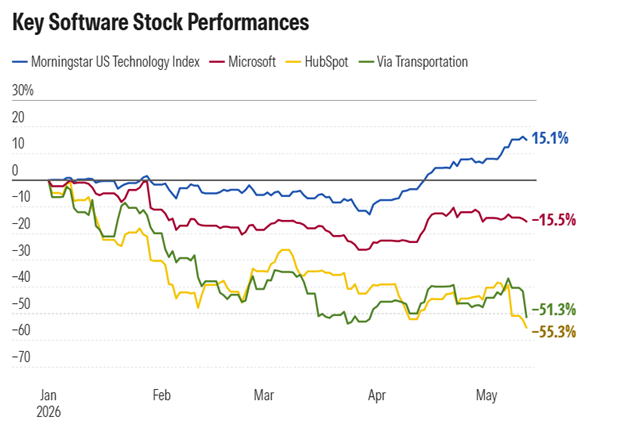
Image Source: Morningstar
Why?
Because more and more software investors are worrying about AI potentially disrupting their companies' business models.
That may end up being overly pessimistic. After all, many analysts predict that software companies will simply adapt to new technologies.
But for investors in technology stocks, that means taking a chance.
Holding a broadly-diversified tech stock ETF no longer means getting great exposure to AI innovation. Many of those indexes now contain software stocks that can significantly drag down AI's gains.
The First Phase of Artificial Intelligence IPO Boom Is Here
The next phase of the AI growth cycle is starting now with several IPOs.
Last week, Cerebras Systems debuted on Nasdaq in what's shaping up to be the biggest tech IPO since Uber's initial listing in 2019.
The company raised $5.55 billion, opening its trading at $350 per share, and closing with a 68% increase to a valuation of about $95 billion.
Cerebras builds AI-focused wafers-cale processors for inferencing purposes – the area investors worry could soon become AI's main bottleneck.
But besides signing a $20 billion cloud deal with OpenAI and a massive infrastructure contract with Amazon Web Services, the company faces competition from Nvidia, and poses real customer concentration risks.
Investors should therefore be careful.
But there's another message the market wants to send clearly:
The appetite for AI companies listed on the Nasdaq remains immense.
And the IPO pipeline ahead with Databricks, OpenAI, Anthropic, and Elon Musk's SpaceX xAI company merger, could soon provide us with the biggest wave of tech listings in years.
Nvidia Earnings Could Decide the Future of All AI-Related Stocks
The coming earnings season will hinge on Nvidia's performance.
The street predicts the tech titan will deliver adjusted EPS of about $1.77, and a revenue number of $78.9 billion for this quarter – both implying over 79% YOY growth.
But what truly caught everyone's attention is Nvidia's Q1 data center revenue, predicted to exceed $73.3 billion, which is a near 87% rise from last year.
And with analysts predicting Nvidia's FY 2027 revenues reaching almost $370 billion (about 71% growth), tonight's earnings become extremely crucial.
Why?
Because the market stopped caring about earnings misses long ago.
They assume Nvidia will beat analysts' expectations.
But tonight they'll want to see something different:
Strong guidance for future earnings driven by Nvidia's Blackwell AI chips, hyperscaler demand, and AI spending in infrastructure.
The Two Risks Facing Nvidia and All Artificial Intelligence-Linked Companies
But there are two other problems tech stocks are facing right now.
Rising bond yields and crude oil prices.
Yields on the 10-year and 30-year US Treasuries have climbed to 4.6% and 5.2%, respectively. 30-Year US treasury hit its highest level in 19 years since 2007.
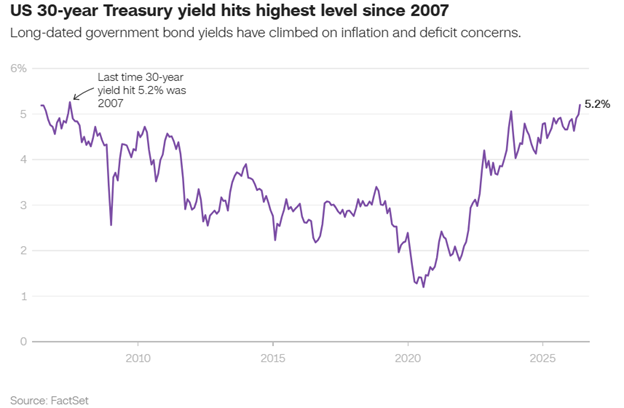
Oil prices are also on the rise due to Strait of Hormuz supply issues, now pushing them above $100 per barrel. This is fuelling fears of renewed inflation and potential tightening by the Federal Reserve.
Why is this relevant?
Because rising bond yields hurt companies valued primarily on their future growth, cutting down the present value of their future cash flows.
That is why the Nasdaq fell and several stocks in Magnificent Seven declined despite posting blowout results.
That leaves two risks investors must consider while watching Nvidia's earnings:
Will the AI growth narrative remain intact for investors? And can artificial intelligence momentum offset rising bond yields?
If Nvidia's guidance for FY 2027 turns out solid and positive for investors with news on Blackwell AI chips, hyperscalers' demands, and AI infrastructure spending... Then Nvidia's decline after the report will create another buying opportunity for premium artificial intelligence stocks.
But if Nvidia fails to impress, rising bond yields can spark a much deeper correction among the entire class of AI tech stocks.
Written by: Saman Ali
Disclaimer:
This article is for informational and educational purposes only and does not constitute financial, investment, trading, or legal advice. Always do your own research or consult a licensed advisor before making trading decisions.
Tech Giants in Motion: Key Updates from Amazon, Google, and Apple
Tech Giants in Motion: Key Updates from Amazon, Google, and Apple
The most advanced technological firms in the world are shaping the future of e-commerce, cloud computing, and consumer devices. This article provides a summary of Amazon, Google, and Apple including their recent developments, financial results, short-term actions, and long-term strategies.
Amazon: Aggressive AI and Logistics Expansion Amid Restructuring
Amazon began as a small online bookstore that was started by Jeff Bezos, however, it is currently one of the leading companies in the e-commerce sector and cloud computing. It shows that the company is capable of continuing to expand and evolve despite the uncertain economy. Main segments such as Amazon Web Services (AWS) have also produced consistent performance, and newer segments, such as advertising continue to develop at an accelerated rate.
Latest Updates:
Amazon reported its net sales as 180.2B in Q3 2025 that is approximately 13% more than in the previous year. AWS contributed to the majority of this growth, as revenue increased by 20 per cent which shows that it is the backbone of the business. Operating income remained constant at 17.4B, indicating consistent earnings, yet cash flow was reduced since the company incurred high expenses on property, equipment, and AI systems as part of short-term expansion strategies. CEO Andy Jassy stated that AI is involved in all areas now, including logistics and delivery, cloud computing, and online shopping.
Amazon has also increased its data center capacity by 3.8 gigawatts in the last year to support more complicated workloads. Meanwhile, same-day delivery is becoming faster and more convenient in rural locations. Prime Air drones are also being equipped to make deliveries within less than 60 minutes in Italy and the UK. As it continues to expand in those regions, Amazon intends to lay off approximately 30,000 corporate employees or approximately 10% of its office workers. It emphasizes that the company is making an attempt to reduce expenses and make operations easier.
Short Term Plans:
Presuming to the Q4 2025, Amazon anticipates net sales to range between 206B - 213B. It shows that the company has no doubts regarding the demand during holidays. It is projected to generate operating income ranging between 21 and 26B. Against the season, Amazon plans to employ 250,000 seasonal employees and increase its same-day delivery further. AI projects are ongoing, and Trainium 2 chips are being deployed and foundation models improved using Amazon Bedrock. The company is also staying on top of the challenges as it is speeding up inventory imports to deal with tariffs. Amazon Bazaar also enters new markets and plans early Black Friday promotions. It emphasizes that the company is prepared to face the busiest shopping season in the year.

Long Term Plans:
Over the long term, Amazon intends to end up automating a significant portion of its processes, potentially eliminating more than 500,000 jobs and saving an estimated 12.6B. Leadership in AWS and AI is also a priority, with more sophisticated models such as Claude by Anthropic. Another important area of focus is expansion of delivery of perishable goods. It shows that Amazon desires to deliver customers in the best way possible despite the kind of products. Project Kuiper is also proceeding, so this shows that the company is looking at launching satellite broadband into those areas which require it the most.
On sustainability, Amazon intends to be fully powered by renewable energy by 2025 and achieve carbon neutrality by 2040. It points out that the firm takes long-term environmental targets seriously. Analysts forecast that Amazon can increase at an annual rate of approximately 11% as far as 2030. It shows that the company is likely to continue increasing its revenue, and the share price would exceed $1,000 by 2040.
|
Category |
Key Highlights |
|
Latest Developments |
- Q3 2025 net sales: $180.2 B (+13% YoY) - AWS growth: +20% - Added 3.8 GW of data-center capacity - Preparing to cut 30,000 corporate jobs (~10% of office workforce) - Expanding same-day delivery, especially for perishable groceries - Prime Air drone rollout planned in Italy and UK |
|
Financials / Guidance |
- Operating income (Q3): $17.4 B - Free cash flow declined due to heavy capex - Q4 2025 net sales guidance: $206–213 B - Q4 operating income guided to $21–26 B |
|
Short-Term Plans (Next ~6– 12 Months) |
- Hire 250,000 seasonal workers for holiday period - Expand grocery same-day delivery in more locations (urban + rural) - Scale up Prime Air deliveries internationally - Invest $100 B+ in AWS / AI infrastructure (Trainium 2, Bedrock foundation models) - Accelerate inventory import to mitigate tariffs - Increase low-cost item offerings via Amazon Bazaar in new markets - Preview and execute aggressive Black Friday deals |
|
Long-Term Strategy (2026+) |
- Use robotics / automation to replace ~500,000 roles and optimize operations - Deepen AWS & AI integration: train and deploy foundation models, expand custom silicon - Expand ultra-fast delivery network for perishable goods |
|
-Build out Project Kuiper satellite broadband for global coverage -Achieve 100% renewable energy by 2025 and carbon neutrality by 2040 -Target sustained ~11% annual revenue growth through 2030; potential stock > $1,000 by 2040 |
Google (Alphabet): Infrastructure and AI Expansion
Alphabet is best known for creating Google Search, which is the world’s most widely used search engine. Additionally, it controls over 90% of the market, and advertising across Google’s platforms has helped Alphabet’s earnings grow over time. Advertising still brings in most of the company’s revenue, while recent improvements in AI have helped Google Cloud grow quickly.
Latest Updates:
Google is also increasing its investment in technology and cloud systems. The company announced a $40B investment in Texas, where it will build three new data centers in Armstrong and Haskell counties. It will also expand centers in Midlothian and Dallas. These sites will handle growing digital demand, increase cloud capacity, and improve energy efficiency.
On the research side, Google is developing new systems that improve ad recommendations and auction scoring. Meanwhile, the company is strengthening its advertising business while also expanding its technology and cloud operations.
Short Term Plans:
In the short term, Google will bring its new Texas data centers online to support advanced digital models. The company is also expanding Google Cloud for business customers and adding new features to tools like Gemini Business add-ons, Forms, and Google Voice.
Additionally, AI Mode is getting upgrades to help with booking tasks and productivity. Cybersecurity, passwordless Gmail, and fraud protection are top priorities. Google is also investing in regional training programs to build more engineering talent. Analysts expect about 11% revenue growth and around 19% earnings growth soon, with an average share target of $316.
Long Term Plans:
Over the long term, Google aims to stay a leading provider of advanced technology for large digital applications. The company will continue building energy-efficient and sustainable data centers to cut long-term costs. Google Cloud will compete directly with AWS and Azure.
Moreover, Google is investing in quantum computing, ambient computing, and autonomous systems like Waymo, Maps, and the Gemini platforms. Analysts expect the stock to reach between
$924 and $950 by 2030, and possibly rise to $2,322 by 2035.

|
Category |
Key Highlights |
|
Latest Developments |
- $40 B investment in Texas for new data centers (Armstrong, Haskell) and expansion in Midlothian / Dallas - Research in ML infrastructure: optimized embedding, RPC coalescing, better error handling - Emphasis on energy-efficient operations and job creation via data-center build-out - Strengthening Google Cloud with AI-first infrastructure |
|
Financials / Guidance |
- Strong cloud growth (AI + enterprise workloads) - Raised capex to fuel infrastructure-scale AI demand - Analysts project ~11% revenue growth in near-term - Expected EPS growth ~19%, average share target around $316 |
|
Short-Term Plans (Next~6–12 Months) |
- Build and operationalize Texas data centers to support foundation models and generative AI - Expand Google Cloud offerings for enterprise AI workloads - Roll out AI features in Workspace (Forms, Voice, Gemini) - Improve security, adopt passwordless Gmail, and increase fraud protection - Develop regional technical training programs for engineers and energy workers - Enhance on-device and cloud AI capabilities (AI Mode, agentic features) |
|
Long-Term Strategy (2026+) |
- Become a global backbone for AI workloads (training + inference) - Scale energy-efficient and sustainable data centers - Compete aggressively in cloud with AWS and Azure - Invest in quantum computing, ambient computing, and autonomous systems (Waymo, Maps, Gemini) - Build strong engineering talent pipelines via training/education - Financial outlook: potential stock price $924–950 by 2030, possible rise to $2,300+ by 2035 |
Apple: Balanced Innovation and Domestic Expansion
Apple, on the other hand, continues using a measured approach that balances hardware innovation, AI integration, and a renewed push for U.S-based manufacturing.
Latest Updates:
- Recently, the company launched the iPhone Pocket in partnership with Issey This accessory comes in two versions: a crossbody model priced at $230 and a short-strap model priced at $150.
- Additionally, Apple announced a $600B U.S. investment plan over four years. This includes an AI server factory in Houston, Texas, which will create 20,000 jobs in areas such as R&D and silicon engineering.
- The company also invested $2.5B in Corning’s Kentucky plant to triple its production of cover glass used in iPhones and Apple Watches. Product innovation continues to drive Apple’s strategy.
- The iPhone 17 lineup has arrived, including the ultra-thin iPhone However, production has been reduced due to lower demand outside China. Apple also released AirPods Pro 3, featuring live translation, improved noise cancellation, and heart-rate monitoring.
- Moreover, the Apple Watch Series 11 has been introduced with a blood-pressure sensor that is still awaiting FDA approval.
- Software and services have also been upgraded with AI-powered features across Apple Maps, Wallet, Pay, Fitness+, and News+, offering highly personalized user experiences. Apple’s silicon roadmap continues to advance with the M5 chip, built on a 3nm process, powering the newest Vision Pro, iPad Pro, and MacBook Air/Pro devices.
- The company has also unveiled a new UI design language called Liquid Glass, which offers a smooth, glass-like visual experience across iOS and macOS. Meanwhile, Apple has delayed the Vision Pro N100 mixed-reality device to focus on AI-powered wearable smart
Short Term Plans:
In the short term, Apple is considering a major redesign of the iPhone, according to Bloomberg’s Mark Gurman. Following the release of the iPhone Air and the updated iPhone 17 Pro in September, the company is reportedly planning three entirely new models over the next three years. The rumored timeline suggests a foldable iPhone in fall 2026, followed by curved glass and an under-display camera in 2027.
Additionally, Apple will continue rolling out AirPods Pro 3 and Apple Watch Series 11. It will expand U.S. manufacturing while integrating AI-powered features across its ecosystem. The company will also focus on optimizing holiday retail strategies and improving software services.
Long Term Plans:
Over the long term, Apple plans to lead in AI-driven personal devices and wearable AR technology. It also intends to expand the integration of its M-series chips while scaling domestic semiconductor manufacturing and R&D. Furthermore, Apple expects to grow its services business by around 30%, contributing to a projected $4 trillion market capitalization.

|
Category |
Key Highlights |
|
Latest Developments |
- Launched iPhone Pocket with Japanese fashion brand Issey Miyake - Announced $600 B U.S. investment over 4 years, including a Houston AI server factory (20,000 jobs) - Invested $2.5 B in Corning’s Kentucky plant to triple glass production capacity - New hardware: iPhone 17, “iPhone Air” (titanium), AirPods Pro 3, Apple Watch Series 11 - Services updates: AI-powered Maps, Wallet, Pay, Fitness +,and News+ |
|
- Introduced the M5 chip (3 nm) and new UI “Liquid Glass” - Delayed Vision Pro N100 to focus on AI-centric smart glasses |
|
|
Financials / Guidance |
- Strong expected holiday quarter revenue (~$140B) - Long-term commitment to U.S. manufacturing and R&D - Services business continues to grow, contributing significantly to profitability |
|
Short-Term Plans (Next ~6– 12 Months) |
- Launch and scale iPhone 17 globally - Ship and promote AirPods Pro 3 and Apple Watch Series 11 - Expand U.S. manufacturing (Corning plant + AI server factory) - Integrate Apple Intelligence features into core apps (Maps, Wallet, Fitness+, News+) - Use M5 chip in newer devices (iPad Pro, MacBook, Vision Pro) - Deploy “Liquid Glass” UI enhancements and smart glass prototypes |
|
Long-Term Strategy (2026+) |
- Lead in AI-first consumer hardware: smart glasses, wearables, AR - Expand M-series silicon across Apple’s device lineup - Fully scale U.S.-based advanced manufacturing and AI infrastructure - Continue aggressive services growth (~30% CAGR) - Leverage on-device AI (Apple Intelligence) for better privacy and performance - Target long-term market cap growth toward $4T via hardware + services integration |
Disclaimer:
This article is for informational and educational purposes only and does not constitute financial, investment, trading, or legal advice. Always do your own research or consult a licensed advisor before making trading decisions.


