

Displaying items by tag: hormuz
How the 2026 Oil War is Dismantling Marine Supplies

How the 2026 Oil War is Dismantling Marine Supplies
Most of us only notice cargo ships when packages are late or food prices spike. But the "hidden engine room" of the global economy is currently on fire.
What was a theoretical worry became a brutal reality on March 8, 2026, when Brent crude surged past $100, eventually peaking at $126 per barrel. While headlines focus on the US-Iran conflict, the real disaster is happening in the water: the Strait of Hormuz, the world’s most vital maritime "throat", has stopped functioning.
When that happens, the questions shift from politics to survival: What do you do when your fuel costs double in a single week? How does a ship keep running when the port it relies on for spare parts is suddenly a war zone?
This is a look at how a $10.1 billion industry is being dismantled in real-time. In this article, we will cover:
- The Fuel Crisis: Why bunker fuel prices have gone vertical.
- The Insurance Blackout: Why ships are grounded even when the water is clear.
- The Spare Parts Trap: How blocked routes are leading to engine failures.
- The Future: Three scenarios that will determine if global trade survives.
Why Marine Supplies Are So Exposed to the Oil War
To get an idea of the scale of destruction, one has to look closer at the share of oil in a ship. Although many people perceive a ship as a transport means, it is much more than that. A vessel can be regarded as a self-sufficient industrial city that requires constant supply of energy and spare parts.
Of course, oil products are needed to power its engines.
Many components of a vessel (e.g., pistons and valves) are made using steel and aluminum.
Logistics, which deliver these parts from warehouses to ships, are based on oil.
In 2025, the global marine spares and equipment industry had generated revenues worth of $10.1 billion, having grown 5.1% in comparison to the previous year. All this stability is now lost. Oil isn't just one factor in this industry; it is the fundamental "DNA" of every single operation.
Bunker Fuel Goes From Commodity to Crisis
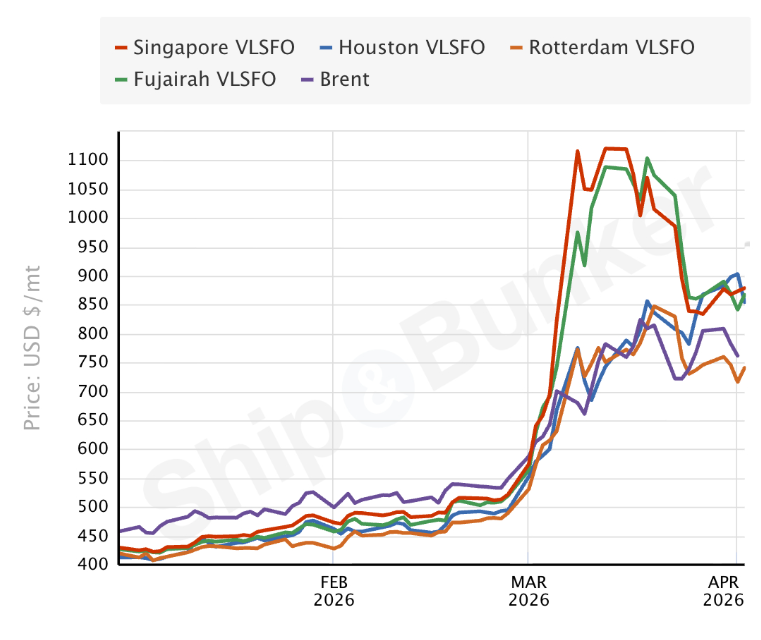
The main component of marine fuels is bunker fuel (Very Low Sulphur Fuel Oil, VLSFO). It accounts for 50% of overall costs of operating a ship. During the recent crisis, VLSFO's price has experienced a vertical growth.
According to Ship and Bunker statistics, VLSFO rate increased by 87% worldwide. Within two months, its price increased from $544 per tonne in late February to $1,125.50 in late March (the record price since the start of Russia-Ukraine War). The dynamics was as follows:
- High Sulphur Fuel Oil (HSFO): Increased its price by 112%, reaching the record high of $886 per tonne.
- Marine Gas Oil (MGO): The most sensitive part of the industry. The prices for MGO have risen by 160% since the beginning of the conflict.
In this regard, Constantinos Capetanakis, Chairman of the International Bunker Industry Association, said: "It's absolutely unprecedented."
The geography of this crisis made things even worse. First of all, one of the largest bunkering centers (Fujairah) was practically out of use after the attacks. Meanwhile, even such giant as Singapore, the largest fueling harbor, recorded the price increase of 106%.
As Maersk CCO put it, "Fuel remains available worldwide, but it is unevenly distributed." This imbalance is a direct consequence of the war.
When Carriers Start Charging Everyone More
Since the shipping companies have to deal with the rising costs, they pass them to consumers. This is where common people experience the consequences of the war, at a grocery shop or at work.
When VLCC supertanker's rate reached $423,736 per day (which is a 94% increase in just 48 hours), they decided to implement surcharges:
- Hapag-Lloyd: Added $160 per TEU in case of dry cargo.
- CMA CGM: Introduced peak surcharge worth of $400 per TEU and separate "Emergency Conflict Surcharge" of up to $3,000 per TEU in case of shipments to Gulf countries.
- Maersk & Seaboard Marine: Started to charge their clients via rolling bunker surcharges starting from late March.
One Indian shipper told S&P Global the situation is so bad that "shippers are not sending any cargo." When the cargo stops moving, the marine supplies stop moving too. It’s a total freeze of the system.
When Insurance Companies Simply Walk Away
As already noted above, marine insurance plays an extremely important role for the operation of ships. In case of absence of War Risk Insurance, vessel owners will bear all expenses related to the loss of property (about $100 mln, typically).
As soon as the conflict erupted, 21 commercial ships got under fire from Iran. In response, major insurers such as Gard, Skuld, and North Standard refused to provide coverage to ships in Persian Gulf area. For those willing to get War Risk Insurance, it becomes rather costly affair:
Peacetime insurance premium: 0.125% – 0.25% of ship's price.
Currently: 0.8% – 1.5%, with US/Israeli vessels insured for 10% or higher.
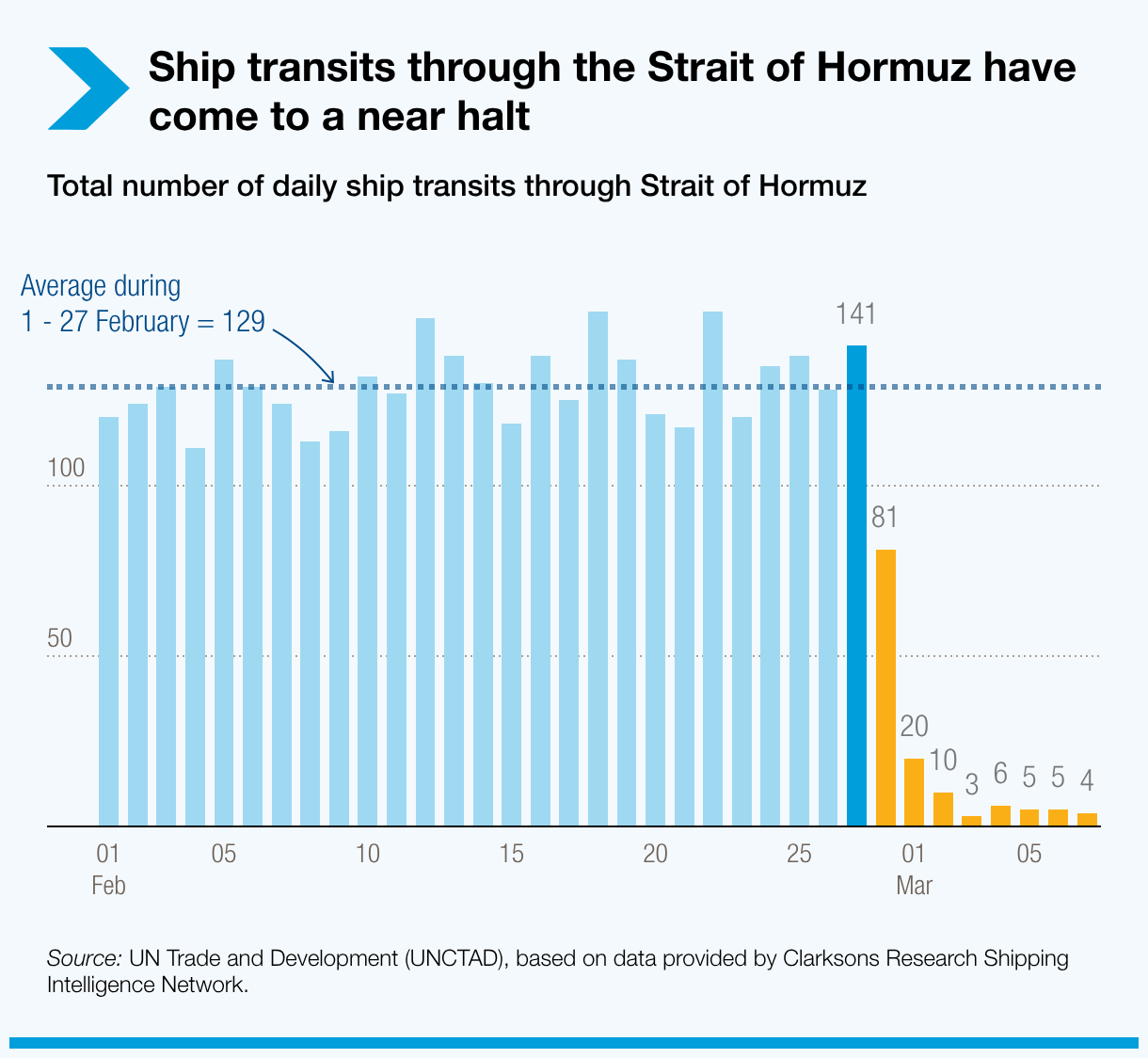
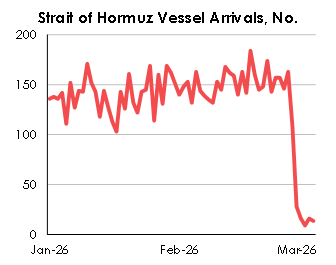
It resulted in a dramatic decrease in transit through the Strait of Hormuz. According to Clarksons Research, currently, only 13 ships managed to pass this waterway in a single week while under normal conditions 250 ships should have gone through. That equals to 95% decline in transit.
|
Peacetime premium 0.125% of vessel value per voyage
|
Crisis premium 0.8–2.5% for standard tonnage
|
US/Israeli-nexus vessels >10% per transit, where available
|
Hormuz transits — latest week 13 vs. ~250 normally (⇩ 95%)
|
What’s Happening to Spare Parts and Ship Maintenance
Of course, fuel is the most obvious aspect of crisis, but the worst may come later. As a matter of fact, the death blow could be delivered by breakdown of spare parts logistics. As mentioned before, ships need regular replacement of parts, which is possible because of four "pillars": Singapore, Rotterdam, Houston, and Fujairah/Dubai.
Now one of them is damaged due to military operations against Iran. As a result, by mid-March almost 1,000 tankers (22% of the global fleet) remain idle in the Persian Gulf.
This results in several negative effects:
- Stockpiling: The owners try to stockpile spares, buying them 30 days in advance, instead of 10. It, of course, affects storage capacity.
- "Cape" Effect: Tankers avoiding Persian Gulf are taking a longer route through Cape of Good Hope. This results in extra wear and tear.
- Deferred Maintenance: This effect can be extremely dangerous. Because spares are either delayed or become prohibitively expensive, the owners postpone their replacement. At some point, deferred repairs cause catastrophic damage to engines.
How Much Worse Could It Get?
As can be seen, the situation is dire at the moment. However, it is still not the worst-case scenario.
The disruption is also spreading beyond oil. LNG markets are now under stress, with tanker rates surging by 40% in a single day after Qatar halted production. The Strait of Hormuz typically handles around one-fifth of global LNG supply, and unlike oil, LNG has limited strategic reserves to cushion disruptions.
According to analysts, the situation is expected to worsen by mid-April. This is when the oil supplies held in the Strategic Petroleum Reserve and the oil supplies currently being allowed to flow due to sanctions are expected to exhaust themselves.
At the same time, geopolitical dynamics are evolving. In later March, Iran allowed selective transit access for ships from China, Russia, India, Iraq, and Pakistan, with Malaysia and Thailand. While this provides limited relief, it also fragments global trade flows and creates unequal access to critical routes.
According to the Kuwait Petroleum Corp.'s CEO, Sheikh Nawaf al-Sabhis, the situation could take three to four months to return to normal even after the conflict is resolved.
This means the situation is here to stay and could set a new standard in the costs of oil and shipping.

There are three possible scenarios which could play out in the near future.
Scenario 1:
If the Strait of Hormuz opens up by mid-April, the prices of bunker oil could fall to between $700 and $800 a tonne. Emergency surcharges could begin to fall off. Logistical issues with spare parts could return to normal. However, the prices of insurance could continue to be high, and the backlog of repairs could take months to resolve.
Scenario 2:
If the situation continues into the second half of the year, the situation would become more severe.
This is because the Philippines has already declared a national energy emergency and depends on the Gulf for 98% of its oil supplies.
The global economic impact is already visible. According to Bloomberg Economics, US CPI rose to 3.4% year-on-year in March, up from 2.4% in February, largely driven by rising fuel costs.
At the same time, more than 44,000 businesses across 174 economies have already had at least one shipment exposed to disruption, highlighting the global reach of the crisis.
UNCTAD has warned of a situation where the costs of foodstuffs, manufacturing, and shipping could escalate due to the prolonged blockage of Strait of Hormuz. Developing countries would be the hardest hit.
At the same time, Singapore's bunker reserves would start to deplete. The reserves are currently maintained through low demand because of high prices. Nevertheless, when the reserves get to a critical level, even the largest bunkering centers would face a problem. This would disrupt the entire network.
Scenario 3:
Should the conflict spread further, affecting Saudi Arabia's oil installations such as Ras Tanura oil terminal, it would result in an unprecedented increase of the prices: $150-$200. In this case, the concept of affordable global shipping would become extinct. The shipping industry simply cannot withstand such price levels.
How the Industry Is Coping
The shipping industry finds itself in survival mode. To cope with it, following measures have been taken so far:
- Maersk is diverting fuel from costlier alternative sources and "slow steaming" (driving ships slower) to save oil. While this saves money, it increases transit times, making everything you buy take longer to arrive.
- The other option is the change in international regulations.
- Industry-wide shift to 30-day fuel procurement advance ordering, up from 10 days has become popular among ship owners.
- Ships have started Stockpiling of critical spares and diversification away from Middle East logistics hubs
- The International Maritime Organization held a special session with the purpose of discussing how to overcome this crisis strategically.
- Additionally, there are talks about transferring the center of gravity of the industry from Houston and Dubai toward Rotterdam and Singapore. However, moving a supertanker requires time.
Conclusion
Today, the marine supplies industry is facing a perfect storm. Previously, similar issues occurred in a localized manner, which meant partial destruction of certain links in the chain. In contrast to this, today, every aspect (fuel, insurance, spare parts and maintenance, routes) is affected. The human price of these changes is rather high. World Food Programme (WFP) warns that the threat of extreme hunger in Africa and Asia could rise to 17-25%, correspondingly.
Also, according to Dallas Federal Reserve research, losing 25% of Hormuz transit could cause global GDP shrinkage to 2.9%. This happens because the shipping process, spare parts delivery, and fuel supply are interrelated. If one link breaks, all others will suffer. Currently, every link in this chain is in dire straits. By mid-April we will see whether they will survive.
Written by: Saman Ali
Disclaimer:
This article is for informational and educational purposes only and does not constitute financial, investment, trading, or legal advice. Always do your own research or consult a licensed advisor before making trading decisions.
The War Premium: Why Oil Prices Will Not Come Down Anytime Soon

The War Premium: Why Oil Prices Will Not Come Down Anytime Soon
Think of it this way. The world's oil supply flows through a single corridor, a narrow, 21-mile stretch of water between Iran and Oman called the Strait of Hormuz. One in every five barrels of oil produced on earth passes through it. And right now, in late March 2026, that corridor is effectively shut down.
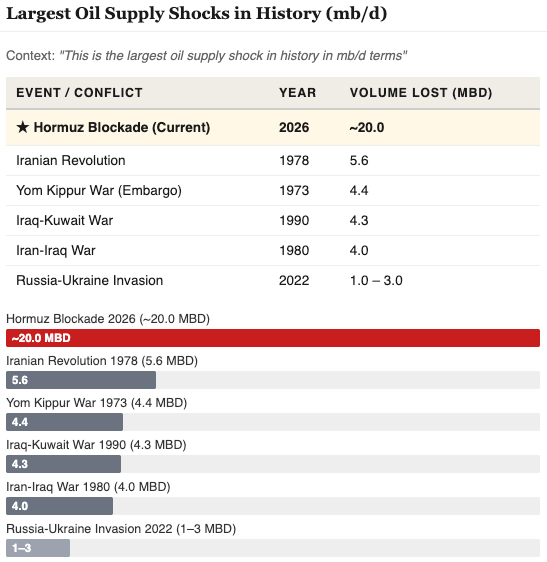
The consequences are not staying neatly contained to oil markets. They are showing up in your petrol bill, your food prices, and quietly, in the cost of every manufactured product that moves on a truck, making it the largest oil supply shocks in history. This piece breaks down what happened, why it matters, and where things go from here.
Where Prices Stand Right Now?
At first glance, the price table looks like any other volatile period in oil markets:
|
Benchmark |
Price |
30-Day Change |
|
Brent Crude (global standard) |
$107.34/bbl |
+34.2% |
|
WTI (U.S. domestic) |
$94.30/bbl |
+21.8% |
|
Dubai/Oman (Gulf physical) |
$111.45/bbl |
+41.0% |
But the number that actually tells you what is going on is not on that table. It is the $12.93 gap between Brent and WTI, the widest it has been since 2011.
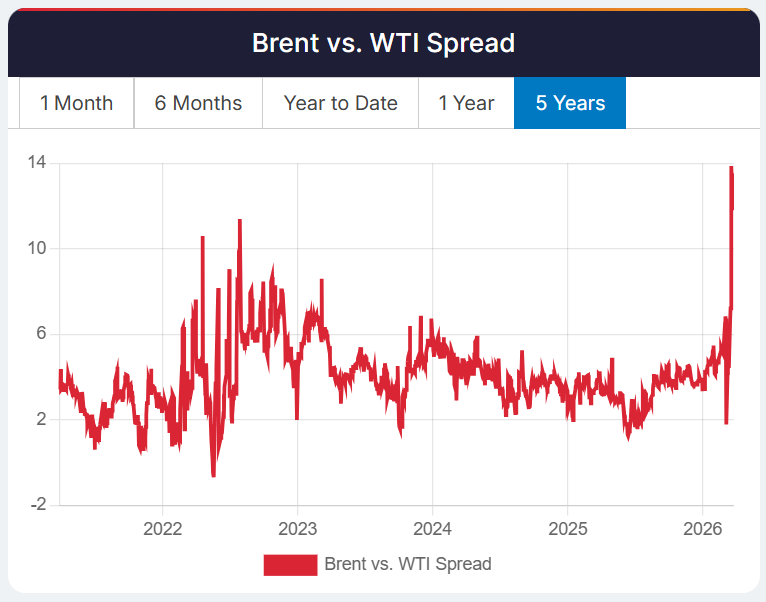
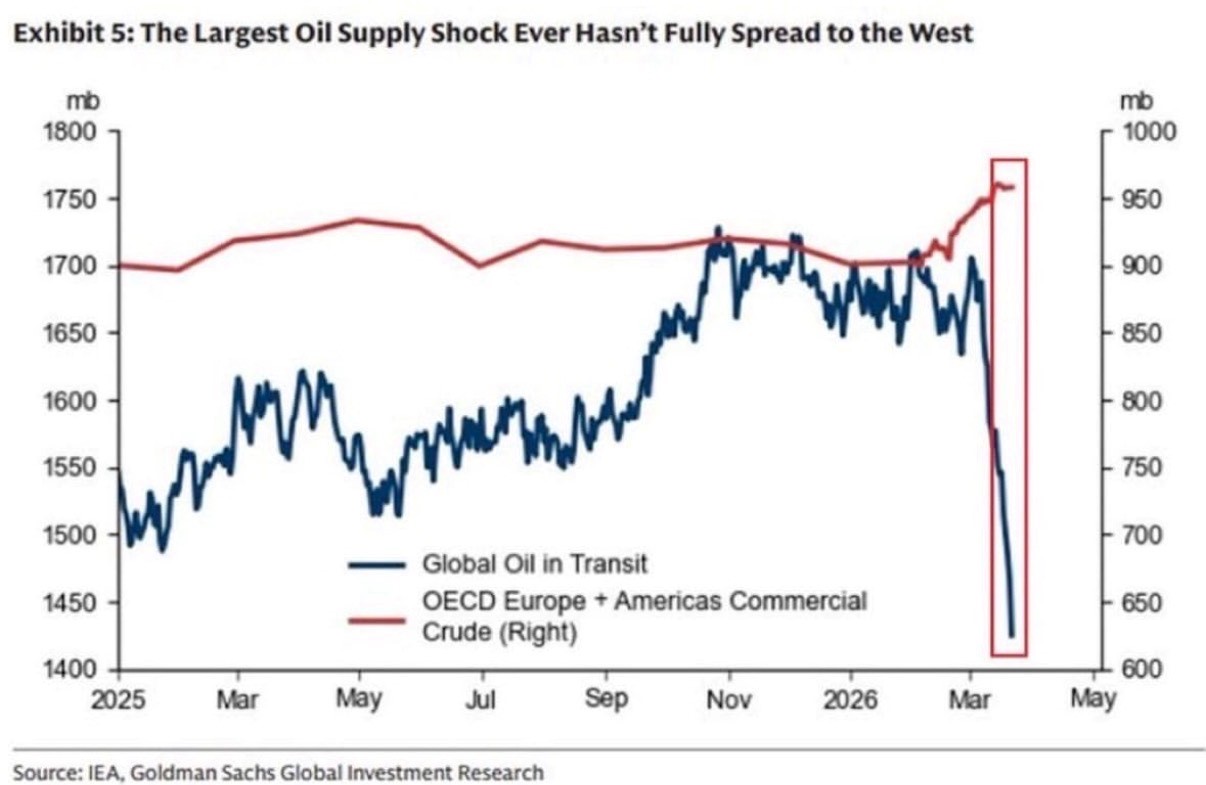
That gap is the market's way of saying: the United States, sitting on record domestic production of 13.7 mb/d, is living in a different energy reality right now than Europe and Asia. America is sheltered. The rest of the world is scrambling. That gap is the scramble made visible.
How Did We Get Here? Crisis Timeline
Nobody should pretend this came out of nowhere. But even people watching closely were caught off guard by the pace.
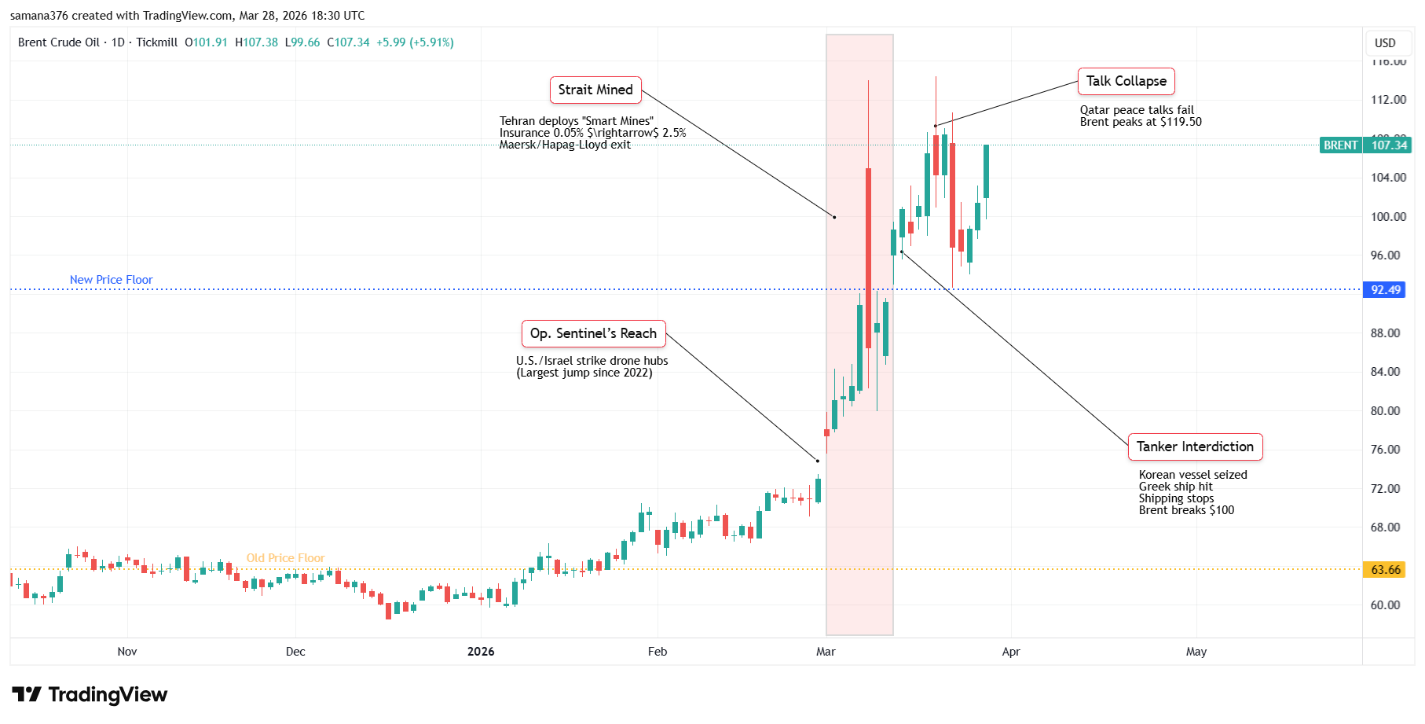
- February 28th was the ignition point. After a series of cyber attacks on regional infrastructure, U.S. and Israeli forces launched Operation Sentinel's Reach against Iranian drone manufacturing sites. Brent jumped $8.40 in twelve hours. That single session move was the largest since Russia invaded Ukraine in 2022.
- The first week of March is when it got structural. Tehran deployed what it calls "smart mines", remotely controlled naval mines, in the narrowest section of the Strait. Within days, shipping insurance costs went from 0.05% to 2.5% of a vessel's total value. Run that math on a $100 million oil tanker and a single voyage now costs $2.5 million just to insure, before you spend a dollar on fuel or crew. Maersk and Hapag-Lloyd, two of the world's largest shipping operators, pulled out of the Gulf entirely.
- March 12th ended any remaining ambiguity. A Korean tanker was seized. A Greek vessel took a hit from a loitering munition, essentially a slow drone that glides toward a target and detonates on contact. Commercial shipping didn't slow down. It stopped. Brent crossed $100 for the first time in four years.
- March 20th was supposed to bring some relief, with peace talks convening in Qatar. They collapsed. Markets drew the obvious conclusion, this is not a blip, and Brent ran to $119.50 before settling back to where it sits today at $108.16.
That pullback is worth addressing directly, because people are misreading it as a sign things are improving. They are not. The floor of this market has moved permanently higher. The retreat from $119 to $108 is not recovery. It is consolidation at a new, elevated baseline.
"Can't the Oil Just Go Another Way?"
It is the logical question, and the answer is: not really, no.
The world normally moves 21 mb/d through the Strait of Hormuz. The only two meaningful bypasses including the Abu Dhabi Crude Oil Pipeline (ADCOP) and Saudi Arabia's East-West Pipeline, can carry a combined 6.85 mb/d at full capacity.
That leaves a gap of over 14 mb/d. There is no pipeline being built, no fleet of trucks, and no emergency reserve large enough to bridge a hole that size. The math simply does not work.
The "Shut-In" Problem: The Crisis Behind the Crisis
Here is the part of this story that deserves far more attention than it is getting.
Gulf oil producers including Saudi Arabia, Kuwait, the UAE, operate almost entirely on a pump-and-ship model. They do not maintain large domestic stockpiles. They produce, and they export, almost simultaneously. So when ships stop moving, the oil has nowhere to go.
By March 15th, onshore storage across the Gulf had hit 95% of total working capacity. At that point, producers face a genuinely ugly choice: keep pumping into a full system, or shut the wells down.
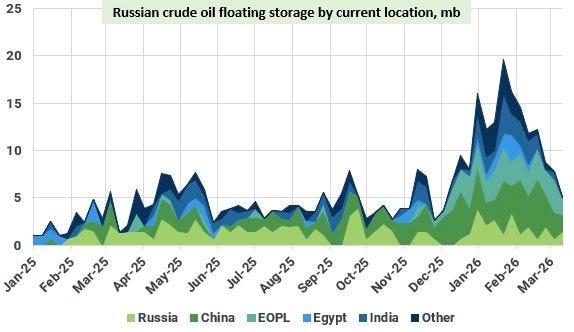
Saudi Aramco has reportedly cut production by around 20%. The reason comes down to geology. Gulf oil fields sit in what are called carbonate rock formations, porous limestone structures where oil pressure and flow behavior are sensitive. Shut a well in this kind of formation improperly, or for too long, and you risk permanent productivity loss. Restarting can take six to twelve months. In some cases, the well never fully recovers.
So when people ask when supply will bounce back once the Strait reopens, the honest answer is: we do not know. Some of this supply may not bounce back at all.
Meanwhile, over 300 supertankers aka VLCCs, the largest class of oil carrier in the world, are sitting idle outside the Gulf of Oman. They are full. The oil exists. The world just cannot get to it, partly because Iranian electronic warfare has filled the Strait's navigation environment with false GPS signals, making it unsafe for a vessel the size of four football fields to attempt the passage. Hence, the crude congestion is escalating.
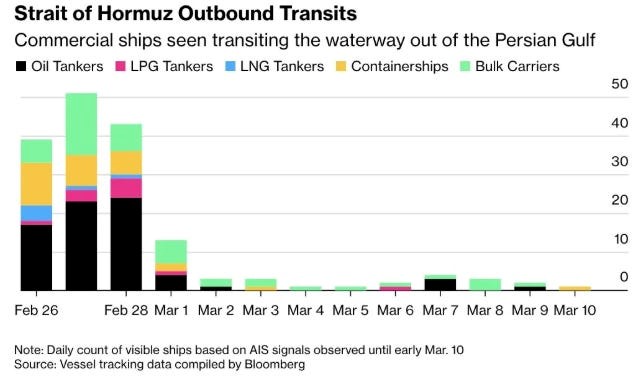
So Why Isn't Oil at $200?
Three things are holding the price below that level, though none of them are permanent solutions.
- U.S. production is genuinely the biggest one. America pumping flat out at 13.7 mb/d has kept WTI below $100 and given Western buyers a real cushion. The catch is geography, a barrel leaving the U.S. Gulf Coast takes 25 to 30 days to reach Japan or South Korea. Asia's need is immediate. The barrel arrives next month.
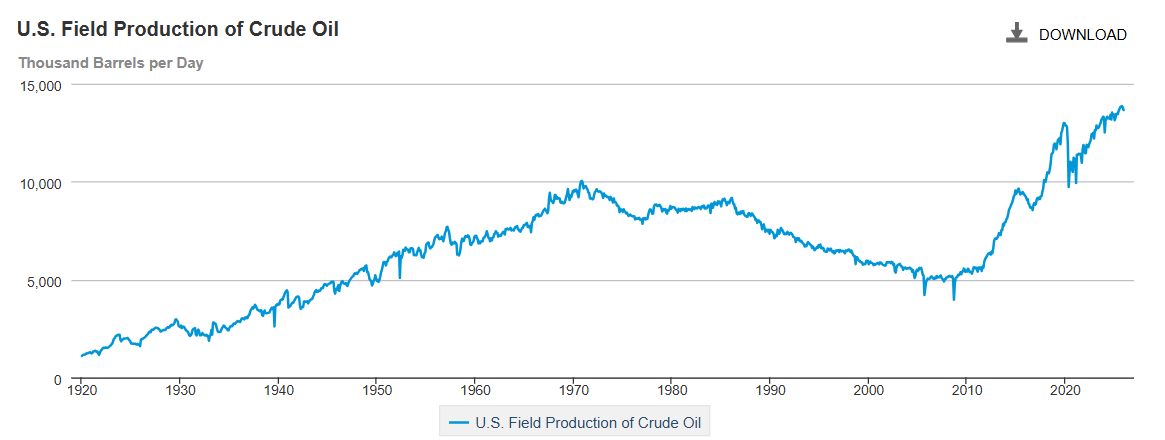
- Emergency reserve releases helped calm the initial panic. The U.S. released 45.2 million barrels from its Strategic Petroleum Reserve on March 11th, coordinated with IEA member nations in one of the largest collective interventions the group has ever organized. It worked on market sentiment. It did not work on logistics. A barrel in a Texas reserve facility cannot physically appear in a Singaporean refinery within the week.
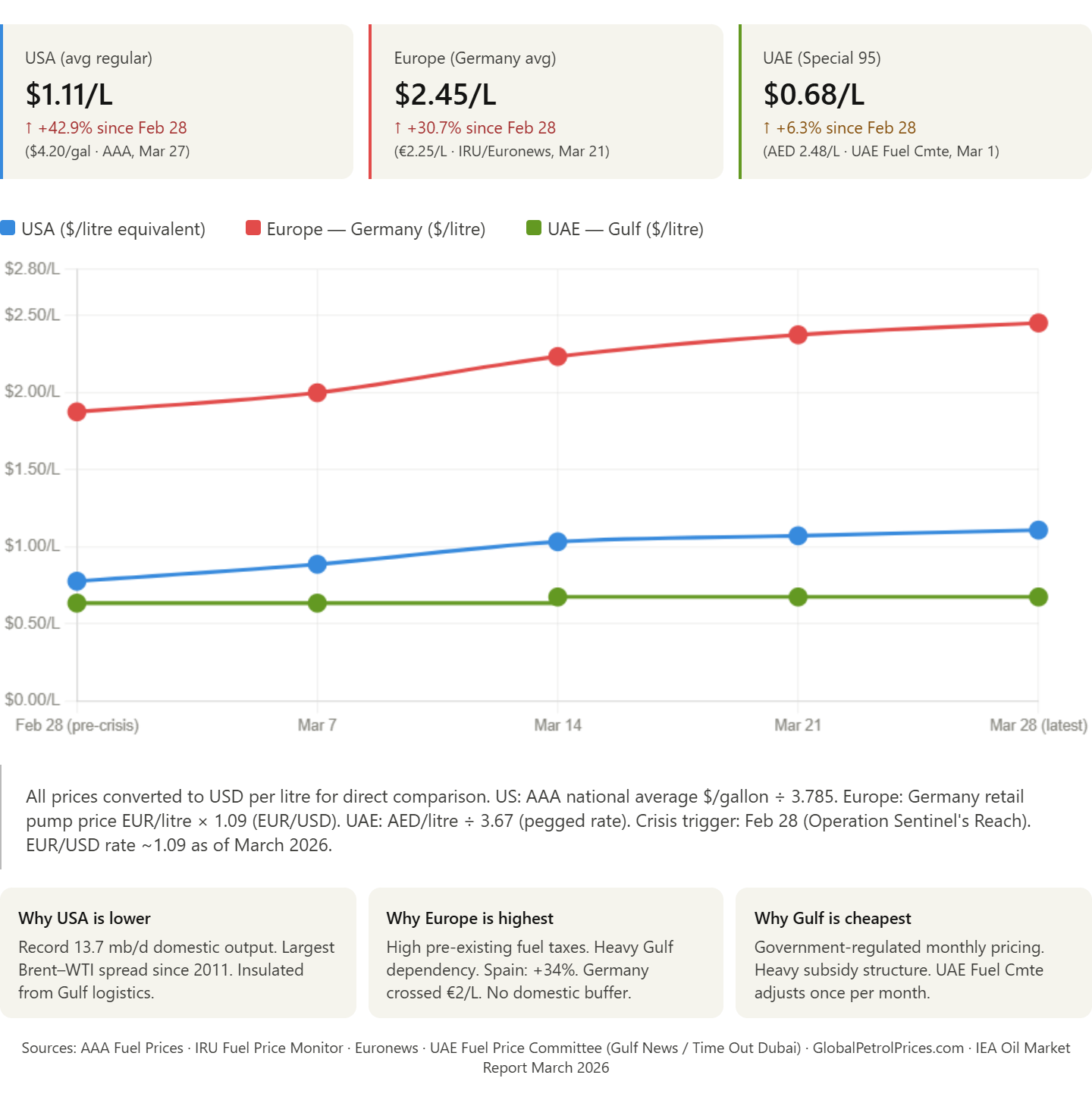
- Demand destruction is the bluntest mechanism of all, high prices forcing people to consume less. At $5.50 a gallon in the U.S. and €2.25 per litre across Europe, discretionary driving has dropped about 12% since late February. People are self-rationing. Prices slow their own rise by reducing consumption. The painful reality is that this adjustment is not distributed evenly. It lands hardest on households with the least financial flexibility and small businesses running on razor-thin margins.
Warflation" — Why This Is More Than an Oil Price Story Economists have landed on a new word for what is happening: Warflation. It describes something different from the inflation most people are familiar with, not too much money chasing too few goods, but military conflict physically destroying the supply chains that keep modern life running. The treatment is different. The trajectory is different. And the damage spreads further.
It is moving through three channels right now.
1- Diesel
Diesel is the first and most immediate. Despite crude sitting at $108, diesel is pricing as though oil were $160. The reason is that diesel requires specific grades of crude; heavier, denser varieties, which come predominantly from the Gulf and from Russian refineries. Those Russian facilities have been steadily degraded by Ukrainian drone strikes over eighteen months. Gulf supplies are now inaccessible. The global middle-distillate market, which powers every truck, train, and tractor on the planet, is functionally broken. The headline crude price understates the economic pressure by a significant margin.
2- Food
Food is the second channel, and it works through a supply chain most consumers never think about. Nitrogen fertilizers like urea, ammonium nitrate, are produced from natural gas, and their shortage will disrupt global food production. Qatar, one of the world's largest LNG exporters, has declared force majeure on its supply contracts. Major fertilizer producers including Yara International and CF Industries have warned of curtailments. Urea prices jumped 19% in a single week in mid-March. That number will show up in crop yields in Q3 2026, particularly across South Asia and the Middle East, regions that are already food price sensitive and have little economic buffer to absorb the shock.
3- Technology
Technology is the third, and the least obvious. TSMC, Taiwan's dominant semiconductor manufacturer, consumes approximately 6% of Taiwan's entire electricity supply. As LNG disruptions raise power generation costs on the island, chip production margins are being compressed. Reports of load-shedding agreements with smaller fabricators are emerging. The global supply chain for AI hardware, already operating with limited redundancy, is being quietly stressed by an energy crisis that started in the Persian Gulf.
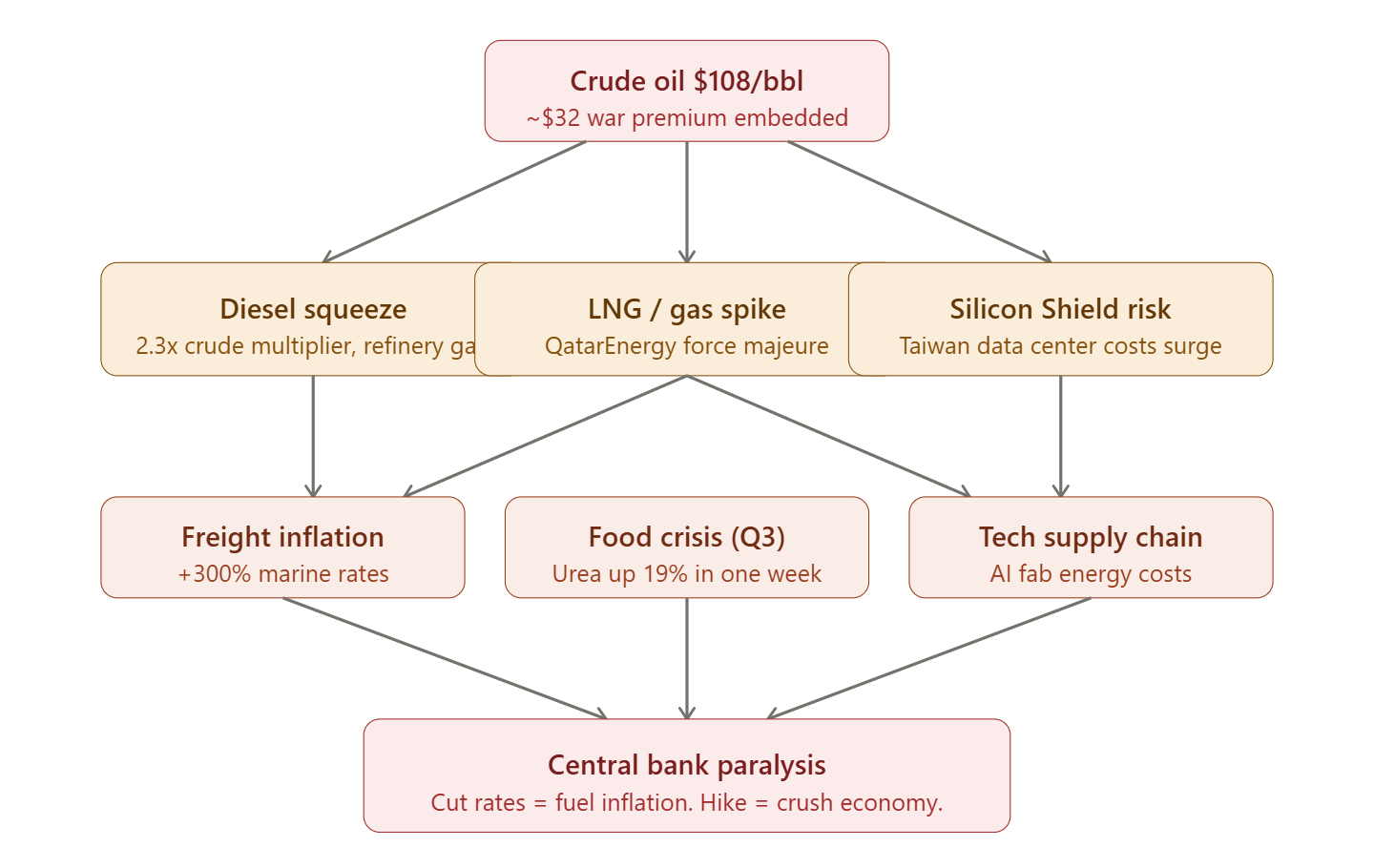
For central banks, all of this converges into a trap with no clean exit. Cut interest rates and you risk entrenching inflation. Raise them and you accelerate the economic contraction that high energy costs are already causing. Neither the Federal Reserve, nor the ECB, nor the Bank of England has a good move available right now.
Possible Ways This Ends – Future Scenarios
|
Scenario |
Probability |
Brent Price |
What It Means for You |
|
Fragile Truce — guarded naval corridor established |
45% |
$90–$105 |
Zero growth, persistent 5% inflation. Expensive, exhausting, but no collapse |
|
Full Escalation — strikes on Saudi oil infrastructure |
35% |
$150–$180 |
1970s-style recession. Trade seizures. Capital flight |
|
Peace Dividend — diplomatic breakthrough |
20% |
$65–$75 |
Markets rally hard. Inflation cools quickly. Central banks regain room to act |
The base case is not recovery. It is managed deterioration. The world learns to live with restricted supply, elevated prices, and structural inflation that refuses to shift. A heavily escorted maritime corridor keeps oil trickling through the Strait at reduced volumes and enormous cost. Growth stalls. Prices stay high. Nobody wins cleanly.
The escalation scenario at 35% is the one that keeps energy analysts genuinely worried. A strike on Saudi Arabia's Abqaiq processing complex — which handles around 7% of global crude supply — would not just block the pipe. It would damage the pump. The price response would be immediate and severe.
The peace scenario at 20% is real, but requires political developments that have no visible pathway right now.
Summing Up
For seven decades, the global oil system operated on one foundational assumption: oil that is produced will be delivered. Price moved. Delivery did not.
The Strait of Hormuz crisis has inverted that. Delivery is now the variable. No rate decision, no reserve release, and no reduction in driving habits can reopen a mined shipping lane or restart a shut-in well on a faster timeline than geology allows.
The winners of the 2026 economy will not be whoever finds the cheapest barrel. They will be whoever can guarantee that the barrel actually shows up.
Written by: Saman Ali

Claim your 50% Deposit Bonus with PU Prime, up to $10,000 by clicking HERE. Sponsored.
Disclaimer:
This article is for informational and educational purposes only and does not constitute financial, investment, trading, or legal advice. Always do your own research or consult a licensed advisor before making trading decisions.
Four Outcomes for Oil After the Iran Escalation - From Risk Premium to Route Closure

The oil market doesn’t need actual barrels to go missing to rally—it only needs the credible possibility that barrels might go missing, fast. That’s exactly what traders woke up to this weekend after the latest escalation involving U.S. and Israeli strikes on Iran, and the equally important follow-on: the messaging around the Strait of Hormuz.
By the numbers, the Strait of Hormuz remains the world’s most dangerous energy chokepoint. In 2024, flows through Hormuz averaged about 20 million barrels per day—roughly 20% of global petroleum liquids consumption. When you add the LNG dimension, the concentration risk becomes even uglier: EIA estimates roughly 20% of global LNG trade transited Hormuz in 2024, primarily from Qatar.
So the question for oil isn’t whether geopolitics matter—they always do. The question is whether this episode stays in the familiar lane of “risk premium” or breaks into the lane of “physical disruption.” The difference between those two states is the difference between crude drifting a few dollars higher… and crude gapping violently while refiners and governments scramble for contingency supply.
The market is already paying for risk—and it’s doing it with urgency
Even before the weekend’s latest headlines, crude was already reacting to the broader U.S.–Iran tension. Reuters reported Brent closing around the low-$70s after climbing on supply-risk focus in late February, reflecting a market that had started to reprice tail risk.
What changed with the latest reports is the perceived pathway from tension to disruption. When an EU naval mission official says Iran’s Revolutionary Guards issued radio transmissions indicating ships’ passage through Hormuz was “not allowed,” markets don’t wait for stamped paperwork. They start imagining insurance premiums, rerouting, delays, and the operational chaos that can reduce effective supply even if production hasn’t dropped yet.
Meanwhile, the public diplomacy has turned dark enough that even the UN Secretary-General referenced “reports that Iran is closing the Strait of Hormuz for international shipping” in remarks to the Security Council—language that underscores how seriously this is being treated at the highest levels, even as details remain fluid.
Why a “Hormuz story” is not just a headline story

There’s a common misconception that a Hormuz event must mean a neat, binary closure—open one day, closed the next. In practice, a Hormuz shock can arrive in gradients:
-
Harassment and warning broadcasts
-
Boardings, seizures, or “temporary” safety measures
-
Missile/drone incidents that raise perceived risk
-
Insurance and security costs that change the economics of a cargo
-
De facto disruption where traffic continues but at reduced throughput, longer queues, and higher costs
That spectrum is exactly why oil can spike even without a clear, official declaration. Shipping doesn’t like ambiguity; insurers like it even less. And commodity markets price the marginal barrel—the one that suddenly becomes hard to move—not the average barrel.
What happens to oil next depends on which of four paths we enter
I’ll lay out the scenarios the way a crude desk would think about them: not as predictions, but as tradeable states of the world.
Scenario 1: The “risk premium only” regime (contained, noisy, but flowing)
In this path, strikes and rhetoric persist, but actual exports from the Gulf continue with manageable disruption. Tankers still sail. Refineries still run. The market adds a geopolitical premium, then gradually bleeds it as traders get comfortable that flows are intact.
This is the kind of environment banks and analysts often describe as a limited disruption case. Reuters cited Barclays noting Brent could rise meaningfully if disruptions occur, while also acknowledging the possibility of de-escalation without supply impact; even a ~1 million bpd disruption would matter because it could erase an expected surplus.
Oil implication: Brent likely holds a firmer floor, rallies on alarming headlines, sells off on “no impact” evidence—classic whipsaw. Volatility stays elevated. The curve may tighten (near-term barrels bid), but not explode.
Scenario 2: Iran’s own supply constrained (sanctions-plus or infrastructure shock)
The market can absorb a lot of geopolitical drama until it touches the plumbing. If Iran’s production, storage, loading terminals, or export logistics are impaired—whether by direct hits, cyber, sabotage, or tighter enforcement—then you’re into a more tangible deficit narrative.
The key is psychology: even if headline export numbers don’t collapse, uncertainty can force buyers to seek alternatives, pushing differentials wider and tightening prompt supply.
Oil implication: Expect a stronger bid in the front of the curve, with heavier strength in sour grades if those barrels become harder to source. Refiners (especially in Asia) may pay up for substitutes.
Scenario 3: “De facto Hormuz disruption” (partial throughput loss, insurance shock, rerouting)
This is the scenario the market fears because it doesn’t require a dramatic announcement—only persistent risk. The Reuters report about warning transmissions is the kind of catalyst that can push underwriters and shipowners into defensive behavior.
Even if only a portion of traffic slows, the effect can be nonlinear. Cargo timing matters. Refiners are inventory businesses. A few delayed cargoes can trigger aggressive spot buying elsewhere.
Oil implication: A larger and more durable risk premium. Tanker rates and freight spreads rise; delivered costs jump. Brent can move sharply even if global production is unchanged, because “available oil” becomes “available delivered oil.”
Scenario 4: The nightmare tail—attempted closure of the Strait of Hormuz
If Iran truly attempts to block Hormuz in a sustained way, the immediate market problem is not forecasting; it’s triage. The EIA’s numbers tell you why: Hormuz is not a niche route—it’s a central artery, moving about 20 million bpd.
This is where you stop talking about $3–$5 moves and start talking about discontinuous pricing—because the world cannot quickly replace that transit capacity. Some barrels can reroute through pipelines, some can be drawn from storage, some can be offset by demand destruction. But none of those are instant, and markets trade the first 72 hours brutally.
Oil implication: A potential price shock that is measured in tens of dollars, not single digits, depending on duration and the credibility of enforcement. Volatility spikes across crude, refined products, and freight. Central banks start paying attention again.
Can OPEC “fix it”? Only partially—and not immediately
In theory, spare capacity is the fire extinguisher. In practice, spare capacity is political, operational, and not all barrels are equal.
A commonly cited estimate from the International Energy Agency (reported by Reuters) put OPEC spare capacity around 5.3 million bpd, with Saudi Arabia ~3.1 million and the UAE ~1.1 million (as of early 2025 context).
But even if you accept the headline number, spare capacity doesn’t solve Hormuz if the problem is transit. You can pump more oil, but if ships can’t move safely—or insurance makes it uneconomic—then “capacity” becomes theoretical. Also, spare barrels often differ in quality from what refiners are configured to run, and the ramp-up isn’t a light switch.
Bottom line: OPEC can cushion a supply shock; it can’t instantly neutralize a shipping chokepoint shock.
The U.S. SPR and coordinated stock releases: a pressure valve, not a cure
Strategic reserves are designed for a moment like this—buffering short-term disruption and calming panic. But again: SPR is a bridge, not a replacement for a functioning trade route. It buys time for rerouting, for diplomatic openings, for demand response, and for non-OPEC supply to react. It doesn’t restore Hormuz.
If the market senses policymakers are willing to act early, it can cap the extreme top. If the market senses hesitation, it will do what it always does: price the worst first, then walk it back later.
Secondary impacts traders will underprice at first—and then chase
Even if crude becomes the headline, the knock-on effects can be just as market-moving:
-
Refined products
Diesel and jet fuel often react more violently than crude in disruption scares because logistics and refinery margins matter. Airlines and shipping lines become immediate pressure points. -
Shipping and insurance
Freight can become a second oil shock layered on top of the first. In stress, delivered prices diverge sharply by region. -
Natural gas / LNG
With a large share of LNG trade flowing through Hormuz (especially Qatari volumes), gas markets can seize up, pushing fuel switching demand back toward oil in some regions. -
FX and rates
Oil exporters’ currencies can catch a bid; oil importers can suffer. Higher oil also complicates inflation narratives—especially if the shock looks persistent.
What to watch now: the “tells” that separate panic from a real supply crisis
If you want to write like a market person, you don’t just repeat headlines—you monitor the tells:
-
Shipping behavior: Are tankers queuing? Are owners refusing charters? Are AIS gaps increasing?
-
Insurance pricing: War-risk premiums are one of the fastest truth-serums in geopolitics.
-
Physical differentials: If prompt differentials blow out, that’s the market screaming “real tightness,” not just paper fear.
-
Forward curve: A true supply shock usually drives backwardation—front month surging relative to later months.
-
Official signals: Naval advisories, port status, and government statements matter more than social media fragments.
And, crucially: watch whether the situation drifts toward a long, messy “gray zone” in the Strait—because markets can live with a one-off spike, but they struggle with chronic uncertainty.
A sober conclusion: oil can rally on fear, but it only stays high on facts
Right now, the oil market is straddling two realities. One is familiar: geopolitical risk premium, elevated volatility, headlines that move futures more than tankers. The other is rarer: the prospect that the world’s most important chokepoint becomes contested in a way that changes physical flows.
Reuters reporting has already put the two key ingredients on the table: the escalation itself and the very specific Hormuz messaging that makes shipping nervous. And the EIA numbers explain why the market can’t shrug this off: Hormuz is not a side road—it’s the highway.
For traders and investors, the disciplined approach is not to marry a single narrative. It’s to treat this as a scenario market:
-
If flows hold: oil likely carries a premium, but spikes can fade.
-
If exports degrade or shipping slows: oil can reprice higher and stay nervous.
-
If Hormuz becomes functionally impaired: price discovery gets ugly fast.
In other words, this isn’t just about Iran. It’s about the market confronting, once again, the uncomfortable truth that global energy security is still built around a few narrow maritime corridors—and when those corridors come into question, oil doesn’t move like a commodity. It moves like a stress test.
MARKET SNAPSHOT | ENERGY RISK PRICING SHIFTS FROM “HEADLINES” TO “TRAFFIC”
-
Shipping behavior: Reuters cited major oil, fuel and LNG players suspending shipments via Hormuz, with satellite/tanker-tracking indicators showing vessels pausing near key regional ports; multiple LNG tankers reportedly slowed, stopped, or altered course.
-
Regulatory/advisory tone: Greece advised Greek-flagged ships to avoid the Gulf/Hormuz area and flagged risks including missile/drone attack, harassment, electronic interference and navigational disruption.
-
On-the-water signal: Reuters reported an EU naval mission official saying the IRGC transmitted that passage was “not allowed”—a message that can trigger war-risk premia even without a formal closure notice.
-
Why the market cares: EIA estimates flows through Hormuz represent about one-fifth of global oil and petroleum product consumption and about one-fifth of global LNG trade (2024), heavily Asia-bound—meaning the shock is global, but Asia takes the first hit.
-
Shock absorbers (limits apply): Reuters (IEA estimate) puts OPEC spare capacity around 5.3 mb/d (Saudi ~3.1; UAE ~1.1), but spare capacity doesn’t solve a transit problem if ships can’t move.
-
Street view: Barclays flagged Brent could reach $80 if supply is disrupted; it also noted that absent disruption, prices could fade as risk premium leaks out.
Markets are now trading probabilities: contained tensions, de facto delays, export disruptions, or a Hormuz shutdown attempt.


